

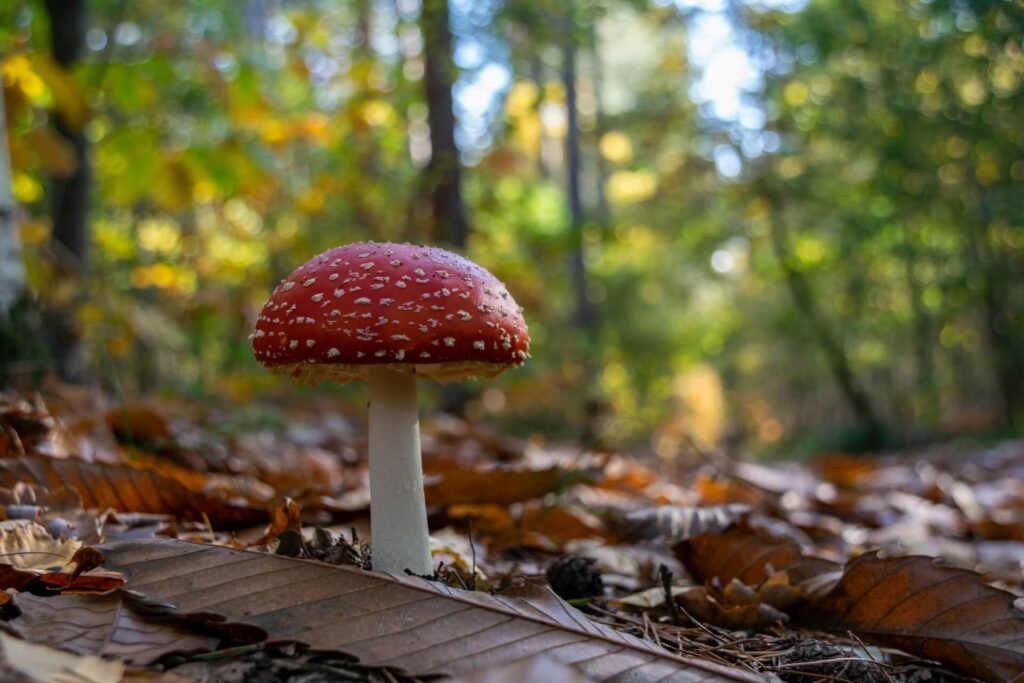
The red and white fly agaric is the mushroom of fairy tales and dreams. For seekers drawn to symbols, it carries a long spiritual story stretching back thousands of years.
That story did not start in a shop. It began in cold northern forests, where the fly agaric, known to botanists as amanita muscaria, became woven into shamanic ritual and folklore. This guide explains what the mushroom has meant to people, and why it still fascinates the spiritually curious today.
Why Has the Fly Agaric Always Felt So Magical?
The fly agaric looks like it stepped out of a storybook. Its bright red cap and white spots appear in art, cartoons, and games. That instant recognition is part of its spiritual pull.
This mushroom is a symbol of mystery and the hidden world. It grows in shady, damp places, near birch and pine roots. People long saw it as a doorway between worlds.
For dreamers and symbol-readers, the fly agaric stands for transformation. It represents the moment when the familiar turns strange and new insight arrives. This echoes older ideas about past life intuition and inherited spiritual gifts. That theme of crossing a threshold runs through almost every legend attached to it.
How Did Siberian Shamans Use the Fly Agaric?
Siberian shamans used the dried fly agaric to enter altered states for ritual and healing. This use is well documented by historians and ethnobotanists.
Shamans of eastern Siberia used the mushroom as an inebriant and a hallucinogen. That pattern appears in the medical history of fly agaric, a 2018 review in a Royal College of Physicians journal. Over time, 4 compounds were isolated from the fungus.
Reindeer-herding peoples such as the Koryak and Khanty are central to this record. Their shamans used the mushroom for divination and contact with the spirit world. The practice followed clear ritual rules.
Several patterns appear across the historical accounts:
- Shamans dried the caps before use, which changed the chemistry and reduced harshness.
- Ceremonial use appears to have been most common, but some cultures also used it as a common folk remedy. In parts of Eastern Europe it was reportedly kept in the medicine cabinet for colds and minor illness.
- Elders guided the practice and watched over participants.
- Songs, drumming, and storytelling framed the whole experience.
- The goal was insight or healing, not entertainment.
These details show a careful tradition. The respect built into the ritual is part of its spiritual meaning.
What Do Folklore and the Soma Theory Say?
Folklore links the fly agaric to fairies, magic, and the winter holidays. Some of these links are old, and some are modern stories told as fact.
One popular idea connects the mushroom to Santa Claus. The theory points to red and white colors, reindeer, and gifts near the hearth. Scholars treat this as a charming hypothesis, not settled history, since the evidence is thin.
A bolder claim involves the ancient Vedic drink called soma. In 1968, the writer R. Gordon Wasson argued that soma was made from the fly agaric. His book made the idea famous, yet many experts dispute it. Treat the soma theory as one contested reading, not proven fact.
What is clear is the mushroom’s role as a symbol. Across cultures it stands for thresholds and the thin line between worlds. That symbolic weight is why it still appears in art about dreams.
What Should You Know Before Exploring It Responsibly?
The fly agaric is not a harmless trinket, and accuracy here protects you. The same compounds that fascinate shamans can cause real harm, like most plants and fungi when dosed and prepared improperly.
The two main active compounds are muscimol and ibotenic acid. Ibotenic acid is the more troubling one. Eaten raw or poorly prepared, the mushroom can cause unpleasant or dangerous effects.
Keep these safety points in mind:
- Much of the fearsome reputation around this mushroom comes from outdated classification and overstated risk. Correct preparation is what really matters, and traditional cultures understood that long before modern toxicology had a framework for it.
- Traditional preparation, such as drying, was used to lower the ibotenic acid content.
- Effects vary widely between people, batches, and doses.
- The U.S. Food and Drug Administration has stated it is not approved as a food ingredient.
- It is not a treatment for any medical condition, so talk to a healthcare professional first.
On legality, the picture is mixed. As of 2026 the fly agaric is not a federally controlled substance in the United States. Louisiana is the 1 state that bans it for human use. Always check your local laws before buying it.
Why Does This Mushroom Still Speak to Seekers?
The fly agaric endures because it sits where nature, story, and mystery meet. It rewards the same curiosity that draws people to dreams, numbers, and symbols.
Its meaning is layered. It is a fairy-tale image, a shamanic tool, and a subject of science at once. Holding those layers together is part of the appeal.
You do not need to consume anything to learn from it. Studying its history sharpens how you read symbols, much like reflecting on the meaning of dreams and quiet states of mind. The mushroom becomes a teacher about thresholds, respect, and the limits of what we know.
What to Carry Away From the Fly Agaric
- The fly agaric, or amanita muscaria, is a powerful spiritual symbol of thresholds and transformation.
- Siberian shamans used it in ritual for divination and healing, under strict guidance.
- Folklore links it to fairies and Santa Claus, though those stories are debated.
- The soma theory from 1968 is contested and should be read as one hypothesis.Its connection to early Christianity runs deeper than most people realize, appearing in a striking number of medieval frescoes, illuminated manuscripts, and church murals across Europe.
- In its raw state, the mushroom contains more ibotenic acid, which can cause unwanted side effects in high doses.
- It is not federally scheduled in the United States, but Louisiana bans human use.
A Symbol Worth Studying With Care
The fly agaric is far more than a pretty mushroom. It is a living symbol of the human urge to cross thresholds and touch the unknown. Approached with knowledge and respect, it offers rich lessons for any seeker, even from a safe distance.
FAQ
What Does the Fly Agaric Mushroom Symbolize Spiritually?
It symbolizes thresholds, transformation, and hidden knowledge. Many traditions saw it as a doorway between the ordinary world and the spirit world. For modern seekers, it marks the moment familiar things turn strange and new insight arrives.
Did Siberian Shamans Really Use It?
Yes, this use is well documented. Reindeer-herding peoples such as the Koryak and Khanty used the dried mushroom in ritual for divination and healing. The practice was guided by elders and framed by song, drumming, and strict rules.
Is the Santa Claus and Soma Connection True?
Both are theories, not proven facts. The Santa link rests on red and white colors and reindeer imagery. The soma idea comes from R. Gordon Wasson in 1968 and remains hotly contested among scholars.
Is the Fly Agaric Safe to Handle or Consume?
It can cause unwanted side effects when raw or poorly prepared, because of ibotenic acid. It is not approved as a food and is not a medical treatment. Check your local laws and speak with a healthcare professional before considering any use.