

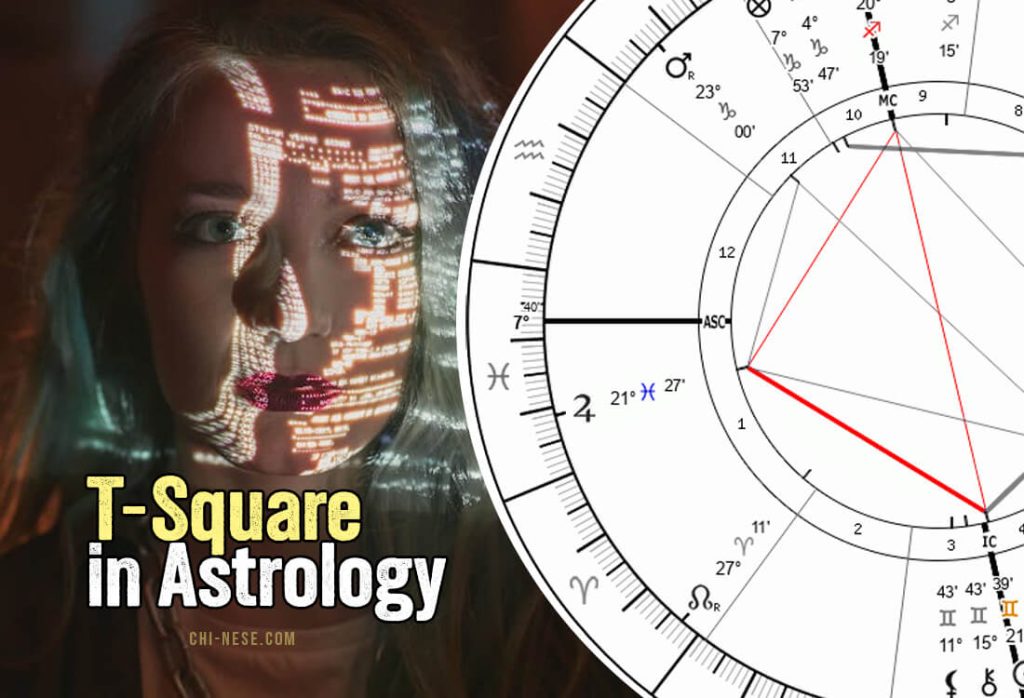
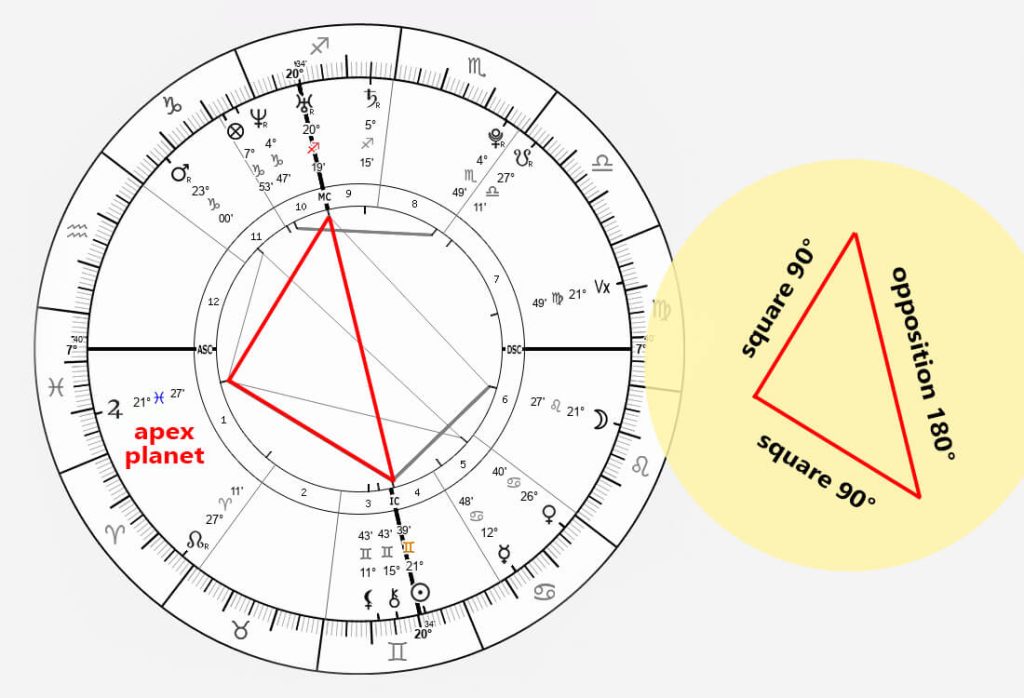
A T-square in astrology is an aspect pattern formed by three planets: two planets in opposition, with a third planet squaring both. It is associated with inner conflict, ambition, frustration, and a strong desire to overcome obstacles. In a natal chart, a T-square may explain why certain problems keep returning throughout someone’s life. In synastry, it can create powerful attraction alongside arguments, jealousy, or competing priorities.
The planet squaring both ends of the opposition is called the apex. It receives pressure from both planets, and its sign and house show where much of the tension is expressed.
T-squares with tight orbs, personal planets, or placements in angular houses (1st, 4th, 7th, and 10th) can have a stronger influence on someone’s life. A Moon-Mars-Saturn T-square may involve anger, emotional insecurity, and problems with authority, while Mercury-Jupiter-Neptune may indicate overthinking, unrealistic expectations, or confusion about beliefs and information.
How a T-Square Is Formed
A T-square consists of an opposition (180°) and two squares (90°). The three planets form a triangle in the chart.
Imagine someone with the Moon at 15° Taurus, Mars at 15° Scorpio, and Saturn at 15° Leo. The Moon opposes Mars, and Saturn squares both planets. Saturn is the apex.
The opposition describes two competing needs or tendencies. In this example, the Taurus Moon seeks emotional security and stability, while Mars in Scorpio may express anger, suspicion, or a desire for control.
Saturn in Leo becomes the outlet for that tension. The person may respond by trying to control their emotions, demanding more from themselves, or becoming unusually concerned about respect and recognition.
The planets and houses involved are more important than simply having a T-square. A Moon-Mars-Saturn configuration involving the 4th and 10th houses may affect family and career, while a Mercury-Jupiter-Neptune T-square could involve education, beliefs, communication, or unrealistic expectations.
Cardinal T-Square
A cardinal T-square involves Aries, Cancer, Libra, and Capricorn and is associated with impatience, ambition, competition, and the need to take action.
Someone with a cardinal T-square may become frustrated by delays or by people who refuse to make decisions. They might start several projects at once, argue with authority figures, or make sudden changes after becoming dissatisfied with their circumstances.
For example, a person with Mars in Aries opposite Saturn in Libra and the Moon in Cancer as the apex may struggle between acting independently, meeting other people’s expectations, and protecting their emotional security.
Cardinal T-squares are especially noticeable if Mars, the Sun, or Saturn is involved.
Fixed T-Square
A fixed T-square involves Taurus, Leo, Scorpio, and Aquarius and is associated with stubbornness, determination, possessiveness, and resistance to change.
Someone with this configuration may remain committed to a relationship, job, or personal goal long after becoming unhappy with it. They may dislike being told what to do and become particularly defensive if someone questions their decisions.
For example, Venus in Taurus opposite Pluto in Scorpio, with Mars in Leo as the apex, may describe intense romantic attachments, jealousy, and arguments involving pride or control.
Fixed T-squares can also indicate exceptional persistence. A person may spend years developing a skill, building a business, or pursuing a goal that others would have abandoned.
Mutable T-Square
A mutable T-square involves Gemini, Virgo, Sagittarius, and Pisces and is associated with overthinking, restlessness, changing plans, and difficulty choosing between competing interests.
Someone with a mutable T-square may constantly reconsider decisions, collect excessive information, or become overwhelmed by responsibilities.
For example, Mercury in Gemini opposite Jupiter in Sagittarius, with Saturn in Virgo as the apex, may describe someone who has ambitious ideas but becomes preoccupied with mistakes, deadlines, and everything that could go wrong.
The person might spend weeks researching a business idea, rewrite the same email repeatedly, or abandon a project after discovering a new interest.
T-Square in the Natal Chart
A natal T-square is associated with recurring challenges, strong motivation, and conflicts involving the planets and houses in the configuration.
For example, someone with the Sun opposite Saturn and Mars at the apex may struggle with authority, criticism, and anger. They may work extremely hard to prove themselves, especially if Saturn represents a demanding parent or an employer who constantly questions their abilities.
If Venus is the apex, romantic relationships, money, or self-worth may become recurring concerns. With Mercury at the apex, arguments, education, siblings, or communication problems may occupy more attention.
A natal T-square involving angular houses is particularly prominent because the conflicts may become visible through relationships, family circumstances, career decisions, or personal identity.
T-Square in Synastry

A T-square in synastry can create strong attraction, emotional tension, arguments, and a sense that another person constantly activates your insecurities or frustrations.
This configuration may form if one person already has an opposition in their natal chart and the other person’s planet squares both ends.
For example, imagine someone with a natal Moon at 15° Taurus opposite Uranus at 15° Scorpio. Their partner has Mars at 15° Leo, squaring both planets and completing the T-square.
The Moon-Uranus person may already struggle between wanting emotional security and needing independence. Their partner’s Mars in Leo may intensify this conflict through jealousy, arguments, sexual attraction, or disagreements about personal freedom.
The Mars person may become frustrated by the Moon-Uranus person’s changing needs. One day, they want closeness and reassurance; the next, they want space.
The person with the natal opposition may find the relationship exciting but emotionally demanding because their partner activates an existing conflict in their birth chart.
The Empty Leg and Grand Cross
The empty leg of a T-square is the point directly opposite the apex. If Saturn at 15° Leo is the apex, the empty leg falls at 15° Aquarius. This point can indicate what the person needs to develop to balance the tension. In this example, Aquarius suggests cooperation, independence, and thinking beyond personal recognition.
In synastry, a partner’s planet can occupy the empty leg and complete a Grand Cross. For example, if their Venus falls at 15° Aquarius, it opposes Saturn and squares the other two planets.
This can intensify attraction, jealousy, or disagreements, depending on the planets involved. The Grand Cross now contains two oppositions and four squares, adding another source of tension to the relationship.
The Orb and Planetary Placements
For T-squares, I use a maximum orb of 2° to 3°. For example, a Moon at 15° Taurus opposite Mars at 16° Scorpio, with Saturn at 15° Leo squaring both, forms a tight T-square. Wider orbs weaken the configuration, especially if the planets barely connect.
The apex planet shows how the person responds to the opposition. Mars at the apex may express tension through anger, competition, or impulsive decisions. Saturn at the apex may indicate fear of failure, excessive responsibilities, or difficulties with authority. Mercury at the apex may lead to arguments, obsessive thinking, or constant questioning.
The house is equally revealing. Mars at the apex in the 7th house may bring conflicts with partners, while Saturn in the 10th may involve demanding employers, career setbacks, or pressure to succeed.
In synastry, a partner’s Mars completing a natal Moon-Saturn opposition may provoke arguments and emotional defensiveness. Venus in the same position may bring romantic attraction mixed with insecurity or fear of rejection.
T-Squares and Ambition
People with a natal T-square may push themselves harder than necessary, even after achieving their goals. Saturn at the apex may indicate someone who works tirelessly but is never satisfied with their success. Mars at the apex may describe someone who thrives on competition and becomes restless without a new challenge.
Czech astrologer Jan Kefer once remarked that people with charts full of squares and oppositions tend to have more eventful lives than those with mostly trines and sextiles. I agree with this view. Difficult aspects can give people the determination to overcome obstacles and achieve things that once seemed impossible.
The apex planet reveals where this determination is directed. Mars may fight for independence, Saturn may pursue professional success, and Venus may spend years trying to build the relationship or financial security they desire.
Other Astrological Aspect Patterns
- Yod in Astrology: The Finger of God or Just a Quirk?
- Quincunx: Good, Bad, or Just Weird?
- Pluto Square Mercury: Obsessive Thoughts, Deep Truths
- When Chiron Transits Natal Lilith: Healing the Wound
- South Node Conjunct Chiron: Karmic Release, Closure, and Growth