


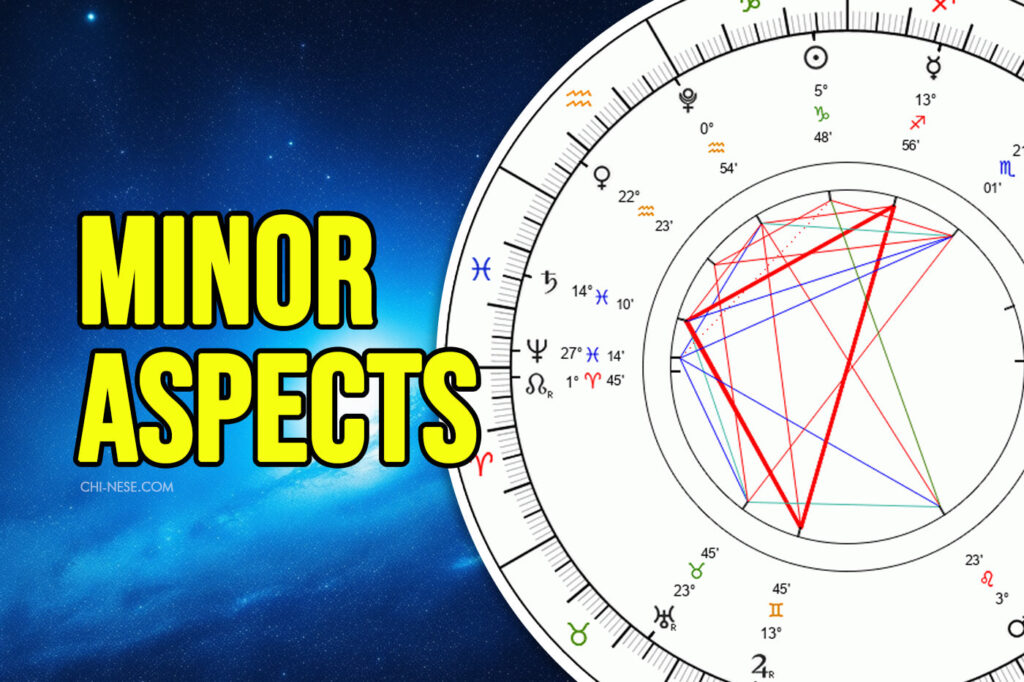
Minor aspects in astrology are the smaller angular connections between planets, such as the semi-sextile (30°), semi-square (45°), quintile (72°), and quincunx (150°). They can describe creative talents, recurring frustrations, unusual interests, and situations that are harder to explain through major aspects alone.
They’re called minor aspects for a reason. Their influence is generally weaker than conjunctions, oppositions, squares, and trines, and many people barely notice them, especially during transits.
Still, I sometimes check minor aspects if a major transit seems completely different from what I’m experiencing. For example, a harmonious Jupiter transit might coincide with an irritating day, and a minor aspect involving Mercury or Mars could help explain the extra tension.
Semi-Sextile (30°): Small Adjustments
A semi-sextile connects planets positioned 30 degrees apart, usually in neighboring zodiac signs. The planets have different elements and modalities, so their interests may be difficult to coordinate.
For example, Mercury semi-sextile Venus might describe someone who enjoys writing romantic messages but struggles to express affection during face-to-face conversations.
During a transit, the semi-sextile may coincide with a small adjustment to your plans, such as changing an appointment, reorganizing your schedule, or finding an easier way to complete a task.
Personally, I consider this aspect quite weak. Unless it involves an important natal planet or repeats alongside stronger transits, I usually give it little attention.
Semi-Square (45°): Irritation and Mental Tension

The semi-square is a 45-degree aspect associated with friction, impatience, and problems that gradually become harder to ignore.
I have Uranus semi-square Mercury in my natal chart, and I associate it with sudden negative thought loops. My mind can jump from one unpleasant possibility to another, even if nothing particularly serious has happened.
During transits, a semi-square might coincide with an irritating conversation, a technical problem, or a last-minute change that interrupts your plans.
Mercury semi-square Mars, for example, could describe snapping at someone over a minor disagreement or sending a message before considering how it might be received.
Quintile (72°): Creativity and Unusual Talents
The quintile is a 72-degree aspect associated with creativity, specialized abilities, and finding original solutions.
Mercury quintile Jupiter might describe someone who enjoys learning foreign languages, writing about philosophy, or connecting ideas from completely different subjects.
Venus quintile Uranus could be associated with unusual artistic tastes, experimenting with fashion, or creating something that other people wouldn’t have considered.
During a transit, a quintile may coincide with finding a new approach to an existing project. Perhaps you’ve struggled with a design for weeks, and suddenly an alternative arrangement makes much more sense.
Bi-Quintile (144°): Developing a Skill
The bi-quintile connects planets separated by 144 degrees. Like the quintile, it’s associated with creativity, but it can also describe the effort involved in developing a particular ability.
For example, Mercury bi-quintile Saturn might describe someone who spends years improving their writing, learning technical terminology, or becoming exceptionally skilled at editing.
Venus bi-quintile Neptune could be associated with photography, music composition, or artistic work requiring patience and imagination.
During transits, you might return to an unfinished creative project, improve a technique, or finally solve a problem that has been bothering you.
Sesquiquadrate (135°): Disruptions and Complications
The sesquiquadrate, also called the sesquisquare, is a 135-degree aspect associated with tension and circumstances that require additional effort.
I remember experiencing Jupiter sesquiquadrate Mercury during a trip abroad. I got a flat tire and had nobody nearby to help me. It disrupted my plans and left me dealing with an unexpected problem in an unfamiliar place.
Of course, a flat tire could happen under any transit. But experiences like this are why I sometimes examine minor aspects after an event, especially if the major transits seem unusually positive.
Mercury sesquiquadrate Saturn might coincide with delayed paperwork, transportation problems, or difficulties communicating with someone in authority.
Quincunx or Inconjunct (150°): Awkward Situations and Adjustments
The quincunx connects planets separated by 150 degrees. The signs involved generally have little in common, which can create situations where two different needs are difficult to satisfy simultaneously.
Some astrologers consider the quincunx a major aspect, so its classification is a little controversial. Personally, I consider it minor. A Saturn quincunx Sun transit might pass almost unnoticed, whereas Saturn square or conjunct the Sun could coincide with major responsibilities, career difficulties, exhaustion, or big changes in your personal life.
For example, Venus quincunx Saturn might describe someone who wants a relationship but struggles to make enough time for dating because of work or family responsibilities.
I like to describe the quincunx as something inside your shoe. It could be a bee, a needle, or a small stone. You have no idea what’s causing the discomfort, but eventually it bothers you enough to stop walking and find out.
I’ve also noticed a difference between the two quincunxes in a transit cycle. The first quincunx, before the opposition, may coincide with a small irritation or a situation that seems manageable. The opposition brings the issue into the open, sometimes through a confrontation or an event you can no longer ignore. The second quincunx, after the opposition, can be surprisingly uncomfortable because you’re already aware of the problem and may have to make an adjustment you previously avoided.
Novile (40°): Spiritual Interests and Personal Realizations
The novile is a 40-degree aspect, created by dividing the zodiac into nine equal parts. It’s associated with contemplation, spiritual interests, and personal realizations.
Someone with Mercury novile Neptune might spend considerable time studying dreams, meditation, or subjects connected with intuition.
A Sun novile Jupiter transit could coincide with becoming interested in a philosophical book, returning to a religious practice, or reconsidering an opinion you’ve held for years.
This is an extremely minor aspect, and I wouldn’t expect a novile transit alone to produce a major life event.
Septile (51.43°): Intuition and Unusual Connections

The septile divides the zodiac into seven equal parts, producing an angle of approximately 51.43 degrees.
In some astrological approaches, septiles are associated with intuition, spirituality, and experiences that seem strangely connected.
For example, Moon septile Neptune might describe someone who takes dreams seriously or becomes interested in psychic experiences.
During a transit, you might encounter a person who introduces you to astrology, begin researching a spiritual subject, or experience a coincidence that stays in your memory.
Septiles require a very tight orb because the aspect is so small. A planet several degrees away from the exact angle would be difficult to interpret as a meaningful septile.
Decile or Semi-Quintile (36°): Small Creative Opportunities
The decile, also called the semi-quintile, is a 36-degree aspect associated with creativity, talent, and developing personal interests.
Mercury decile Venus might describe someone who enjoys writing poetry, creating attractive presentations, or learning calligraphy.
Mars decile Uranus could be associated with experimenting with new exercise routines, technology, or hobbies that require quick reactions.
During a transit, you might become interested in a creative activity you’ve never tried before, such as learning an instrument, editing photographs, or designing your own website.
Why I Check Minor Aspects During Transits
I usually start with conjunctions, oppositions, squares, trines, and sextiles. These are the aspects I consider more important, especially if they involve the Sun, Moon, Ascendant, or personal planets.
Minor aspects come afterward. Their effects can be so small that you might experience an entire transit without noticing anything unusual.
But sometimes a major transit seems completely disconnected from the events of the day. You might have Jupiter trine your Sun and expect an enjoyable experience, yet spend the afternoon dealing with transportation delays or an argument. A simultaneous Mercury semi-square Mars or sesquiquadrate Saturn might offer an additional explanation.
I also pay attention to minor aspects that repeat in my natal chart or involve planets already activated by stronger transits. A minor aspect to natal Mercury may become more noticeable during a Mercury retrograde or a major Uranus transit to Mercury.
For me, minor aspects are worth checking after the major ones. I wouldn’t build an entire transit reading around a semi-sextile or novile, but they can sometimes explain the smaller events that the stronger aspects leave unanswered.
More About Planetary Aspects and Transits
- How to Read a Yod in Astrology: The Finger of God or Just a Quirk?
- T-Square in Astrology: Three Planets, One Powerful Source of Tension
- Mystic Rectangle in Astrology: How This Pattern Works in a Chart
- Benefic and Malefic Planets in Astrology: Venus, Jupiter, Mars & Saturn
- The Rarest Astrology Placements and Their Meanings






, semi-square (45°), quintile (72°), and quincunx (150°).)