


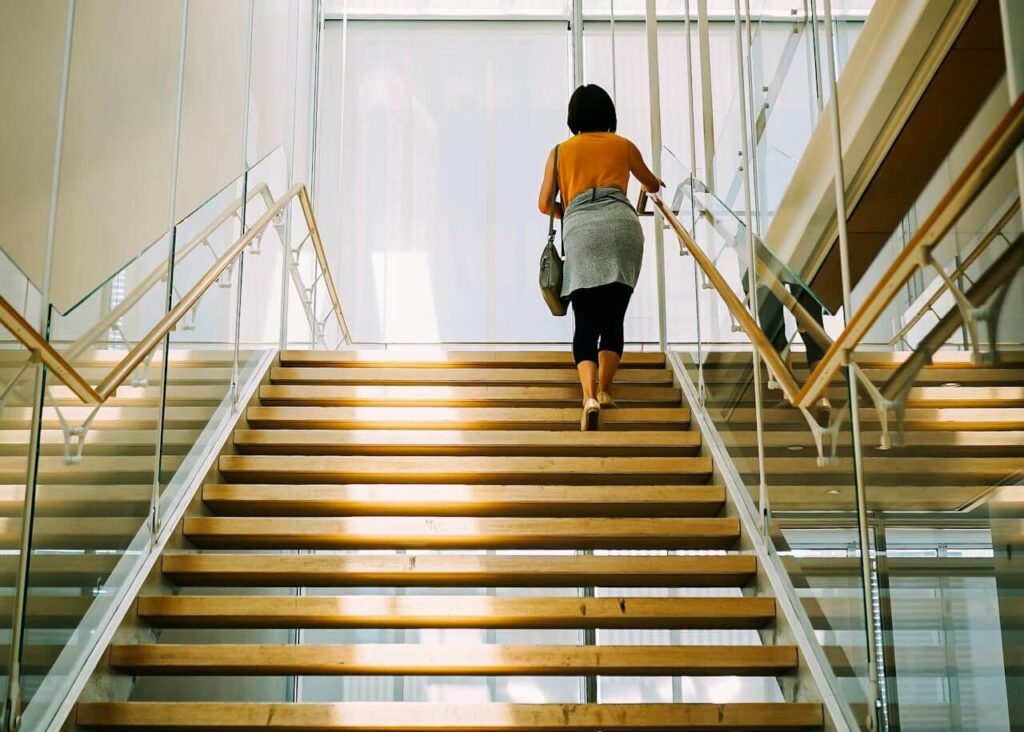
The superstition about crossing someone on stairs is an old belief that says passing another person while one of you is walking up and the other down can bring bad luck, arguments, disrupted fortune, or negative energy. In some traditions, one person is supposed to stop, step aside, or wait on the landing instead of crossing directly in the middle of the staircase.
Why Crossing on Stairs Was Considered Bad Luck
In superstition and folklore, stairs were never viewed as just practical architecture. Staircases symbolized movement between states, levels, or conditions. Going upward became associated with progress, success, growth, status, or spiritual elevation. Going downward became linked with endings, decline, loss, return, or descent into uncertainty.
Because of this symbolism, crossing directly in the middle of the staircase was believed to interrupt or clash with somebody else’s path, direction, or fortune.
In some traditions, the person moving upward was supposed to have the right of way because upward movement symbolized advancement and luck. Interrupting that movement was believed to “cross” their fortune or create obstacles afterward.
Other beliefs described staircases as spiritually sensitive places because they connected separate levels of a home or building. Meeting somebody halfway between those levels was viewed as symbolically unstable or energetically disruptive.
Why Staircases Became Spiritually Significant
Stairs appear throughout folklore, dreams, mythology, religion, and superstition because they symbolize transition. They exist between spaces, between floors, between one level and another.
In older superstition, places that existed “between” were often treated carefully because they symbolized uncertainty, movement, vulnerability, and shifting fortune. Doorways, crossroads, bridges, mirrors, gates, windows, and staircases all carried similar symbolism because they connected one state, space, or condition with another.
People believed spiritually charged experiences happened more easily in transitional places because those locations did not fully belong to one side or the other. That is part of why staircases became connected with fate, luck, omens, spirits, supernatural encounters, energy shifts, and disruption of personal fortune.
Even today, many people instinctively slow down, hesitate, or awkwardly step aside when passing somebody on narrow stairs without fully knowing why.
Stair Superstitions Around the World
Staircases collected superstitions for centuries because they combined symbolism with actual danger. Falling down stairs was a serious risk long before modern buildings, especially in houses with steep staircases, poor lighting, uneven steps, or narrow passageways. Over time, physical caution slowly merged with folklore and spiritual beliefs. That is why so many superstitions became attached to stairs across different cultures.
Walking under ladders became associated with bad luck partly because it was believed to break a sacred triangular shape and partly because ladders were historically linked with punishment, executions, and danger.
Some cultures feared specific numbered steps in staircases, especially the number 13, while others believed certain staircases became spiritually active at night or could symbolically lead people into unfamiliar places in folklore stories.
In parts of Eastern Europe and Russia, people were discouraged from whistling, shouting, arguing, or behaving carelessly on stairs because staircases were viewed as spiritually sensitive areas connected with luck, household harmony, finances, and unseen energy within the home.
Does Crossing Someone on Stairs Actually Bring Bad Luck?
Crossing somebody on stairs does not literally cause bad luck, but the superstition survived for centuries because staircases already carried a strong psychological and symbolic atmosphere. They involve movement, imbalance, narrow space, caution, and transition, which made people attach meaning to them very easily.
Older folklore treated staircases as places where direction, luck, personal paths, and energy could symbolically interfere with each other. Passing somebody halfway between levels was seen as disrupting movement or crossing fortune in an unfavorable way.
Even now, many people still hesitate slightly before passing somebody on narrow stairs without fully thinking about it. That reaction probably comes from generations of cultural habits and stories surrounding staircases as places that were never viewed as entirely ordinary.
More on Superstitions and Omens
- Why Leaving a House by the Same Door Matters (Superstition Explained)
- When a Picture Falls Off the Wall: Spiritual Meaning & Superstitions
- Crows Gathering in Large Numbers: Spiritual Meaning & Superstitions
- Ringing in the Ears When Thinking of Someone: Spiritual Meaning & Superstitions
- Door Knobs Falling Off: Spiritual Meaning & Superstitions