


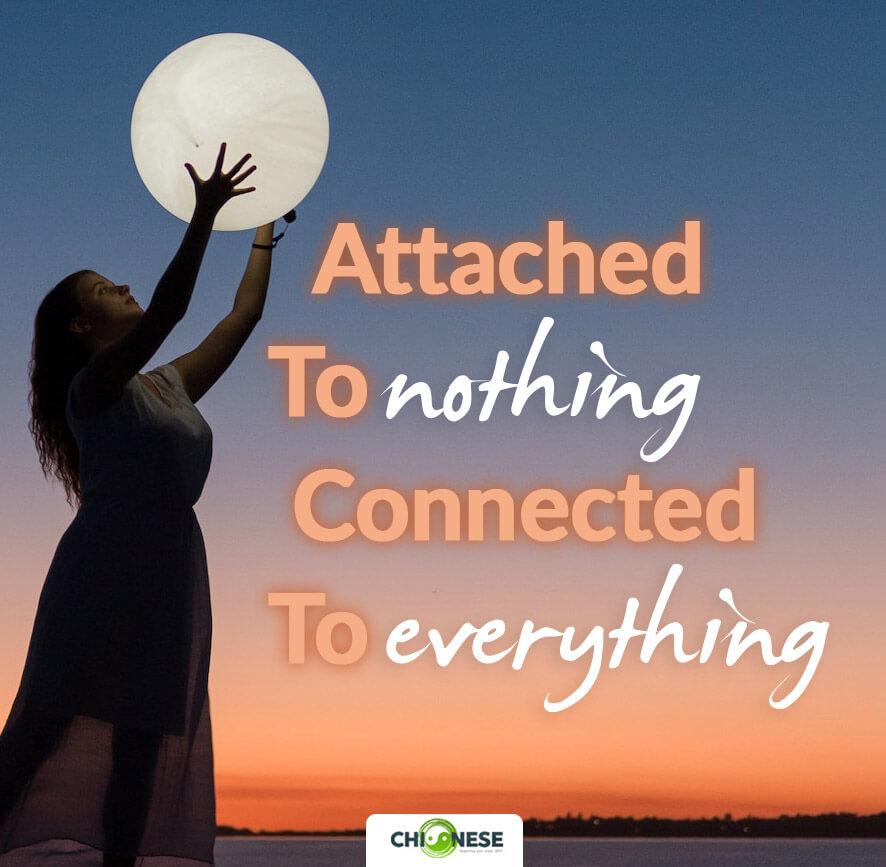
“Attached to nothing, connected to everything” is a spiritual phrase about non-attachment. It means learning how to live, love, care, work, and connect with people without making your emotional stability completely dependent on external things staying exactly the same forever.
The phrase became popular in spirituality, Buddhism, mindfulness teachings, and personal growth discussions because many people eventually notice the same pattern: they keep chasing something they believe will finally make them feel complete. More money. A relationship. Attention. Status. Validation. Physical appearance. A different life situation.
For a short time, getting those things can create excitement, relief, confidence, or emotional comfort. Then the mind moves toward the next thing it believes it still needs.
Spiritually, non-attachment is about stepping out of that cycle. It does not mean becoming cold, emotionless, disconnected, or indifferent to life. It means learning how to enjoy life without emotionally collapsing whenever something changes, leaves, disappoints you, or stops going the way you expected.
The Emotional Side of Attachment
“Attached to nothing” does not mean rejecting relationships, success, money, goals, love, emotional connection, or material things. Spiritually, it means learning how to experience those things without turning them into the entire foundation of your emotional stability, identity, or self-worth.
People often become deeply attached to relationships, validation, appearance, money, status, routines, control, specific outcomes, or the version of life they believe they need in order to finally feel secure or complete.
The problem begins once emotional survival depends entirely on keeping those things exactly the same.
A relationship becomes emotionally consuming once somebody starts believing they cannot function emotionally without the other person. Success becomes psychologically exhausting once self-worth depends entirely on achievement and recognition. Control becomes overwhelming once somebody tries managing every possible outcome to avoid uncertainty, disappointment, rejection, or emotional discomfort.
Underneath attachment, there is usually fear. Fear of abandonment. Fear of instability. Fear of rejection. Fear of uncertainty. Fear of losing control. Fear of being emotionally alone.
Connection Without Emotional Attachment
The second half of the phrase is just as important. “Connected to everything” describes a state where somebody stops moving through life entirely through fear, control, comparison, validation, or emotional possession. Attention starts shifting toward connection itself: relationships, nature, creativity, spirituality, presence, gratitude, emotional openness, and shared human experience.
Ironically, people often connect more deeply once they stop trying to emotionally control everything around them. Relationships become healthier once love stops revolving entirely around jealousy, panic, reassurance, emotional dependency, or fear of losing the other person. Emotional closeness starts feeling calmer because connection no longer depends on possession or constant emotional control.
Life also becomes psychologically lighter once emotional stability stops collapsing every time circumstances change unexpectedly.
Most people learn attachment long before they learn emotional stability. Many grow up believing achievement determines worth, relationships determine identity, approval determines value, and control creates emotional safety.
Because of this, letting go can initially feel emotionally terrifying. A lot of people confuse attachment with love because attachment can feel emotionally overpowering. Obsessing over somebody, needing constant reassurance, panicking over emotional distance, trying to control outcomes, or feeling emotionally destroyed by change can easily become mistaken for deep love or connection.
Spiritually, non-attachment asks a very different question: Can you love deeply without emotionally disappearing inside the relationship?
What Non-Attachment Looks Like in Real Life
Non-attachment usually looks very ordinary from the outside. It looks like somebody accepting change without trying to force everything back under control immediately. Letting relationships breathe instead of monitoring every shift in behavior. Enjoying success without building their entire identity around status or recognition. Experiencing disappointment without turning it into emotional collapse. Allowing emotions to pass instead of clinging to them for months or years afterward.
It also means understanding that uncertainty exists in every part of life. Relationships change. People change. Plans change. Life never stays completely fixed.
With non-attachment, emotions still exist fully, but they stop controlling somebody’s entire emotional stability, identity, and sense of self.