

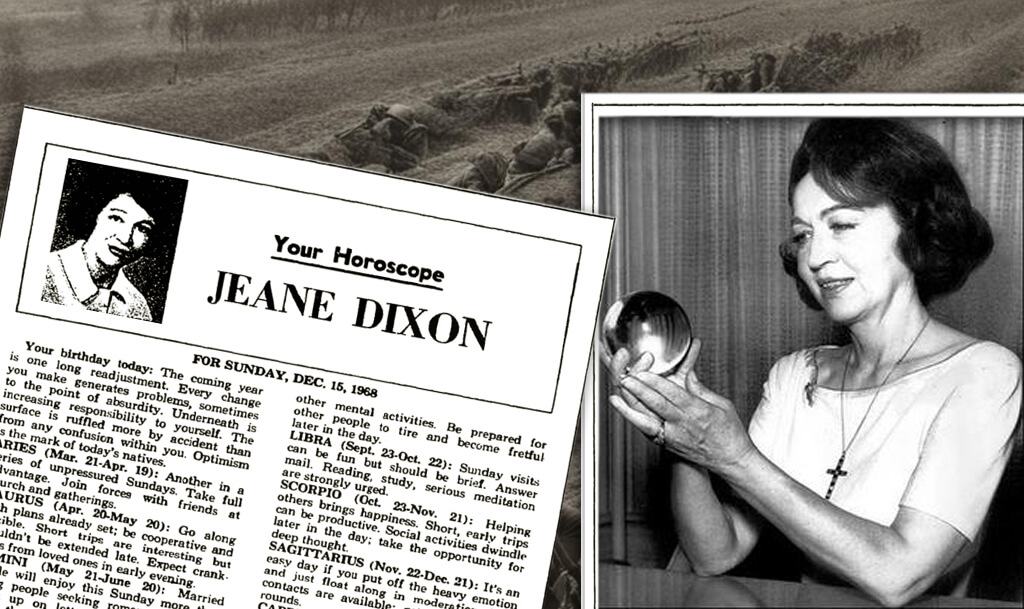
When people talk about famous seers, names like Baba Vanga or Nostradamus usually come up first. Much less often do people mention Jeane Dixon, even though she was one of the most well-known astrologers and psychics in the United States during the 20th century.
Jeane Dixon was a public figure long before the internet made predictions easy to spread. She appeared in newspapers, advised politicians, and became a household name in America. Some of her statements later lined up with real events, while many others clearly did not. That mix of hits and misses is exactly why she remains controversial.
Who Was Jeane Dixon?
Jeane Dixon was born Lydia Emma Pinkham in 1904 in Medford, Wisconsin. She developed an interest in astrology and psychic subjects early in life. In the 1920s, she moved to Washington, D.C., where she began offering astrological readings under the name Jeane Dixon.
Over time, her popularity grew rapidly. More than 400 newspapers around the world published her horoscope columns, and she became known for reading charts for public figures, including actors, politicians, and business leaders. At the same time, critics accused her of making vague predictions that could later be interpreted to fit almost anything.
During her lifetime, she was both admired and openly mocked. Supporters pointed to predictions that seemed accurate. Skeptics pointed out that she made thousands of forecasts, many of which never happened.
Predictions Often Cited as Accurate
The Assassination of Robert F. Kennedy
One of the predictions most often linked to Jeane Dixon involves Robert F. Kennedy. She reportedly warned that a Democratic presidential candidate would be assassinated in the 1960s. Robert F. Kennedy was killed in 1968 during his presidential campaign.
This event significantly increased Dixon’s reputation. Newspapers and supporters began referring to her as “the Seeress of Washington,” and public interest in her work grew sharply afterward.
The Challenger Space Shuttle Disaster
Jeane Dixon made statements warning of a space disaster involving astronauts and a spacecraft breaking apart. In 1986, the Space Shuttle Challenger exploded shortly after launch, killing all seven crew members on board.
Supporters argue that her earlier warnings align with this tragedy, although critics note that space-related accidents had already occurred and were a known risk during that era.
The Fall of the Soviet Union
Dixon is also credited with predicting the collapse of the Soviet Union. She reportedly suggested that Russia’s political system would not remain stable and that major changes were inevitable. The Soviet Union dissolved in 1991.
While some see this as a strong prediction, others point out that political instability within the Soviet system was widely discussed by analysts years before its collapse.
Predictions That Remain Disputed

The 9/11 Attacks
Jeane Dixon is sometimes said to have predicted large-scale terrorism affecting the United States. One of her quoted statements mentions widespread terror, war, famine, and disease.
After the September 11, 2001 attacks, these words were retroactively connected to the event. However, Dixon did not mention a specific date, location, or method, which makes this prediction highly debatable.
Russia and a Third World War
Dixon made several statements suggesting that Russia would play a central role in a future global conflict, sometimes placing this scenario around the early 21st century.
After Russia’s invasion of Ukraine in 2022, some people claimed she had predicted the event. However, her statements were broad and lacked concrete timing or detail. No direct reference to Ukraine or a specific year appears in her published material.
End Times and Armageddon
Jeane Dixon also predicted end-of-world scenarios, including the Second Coming of Christ and Armageddon occurring between 2020 and 2035. According to her writings, a global conflict would lead into these events.
So far, these predictions have not occurred, and most historians and researchers consider them symbolic or incorrect rather than literal forecasts.
Why Jeane Dixon Remains Controversial
One reason Jeane Dixon continues to be discussed is the sheer volume of predictions she made. Like many public psychics, she issued thousands of forecasts across decades. Statistically, some were bound to resemble real events.
Critics argue that her reputation relies heavily on selective memory, focusing on a few apparent successes while ignoring the many predictions that failed or never materialized. Supporters counter that even partial accuracy is impressive.
Lesser-Known Facts About Jeane Dixon
Jeane Dixon died in 1997, one year after the death of Baba Vanga. She wrote a book titled Horoscope for Dogs, which received both praise and ridicule. She was known for advising Nancy Reagan, the former First Lady of the United States, particularly on astrology and timing matters.
Why Her Predictions Still Spark Debate
Jeane Dixon’s legacy sits somewhere between fascination and skepticism. She was undeniably influential, widely read, and deeply embedded in American popular culture for decades. Some of her predictions appear to align with real events, while many others clearly do not.
Whether viewed as insightful, lucky, or simply skilled at phrasing broad statements, Jeane Dixon remains an example of how prediction culture works. People remember what fits, forget what doesn’t, and continue searching for meaning in uncertain times.