

Saturn’s scythe symbolizes time, hard work, harvest, aging, and death. In astrology, Saturn rules limitations, responsibility, old age, and the natural end of life cycles. The scythe represents these themes perfectly. It is a farming tool used to harvest crops, but it is also associated with the Grim Reaper, who carries it as a symbol of death.
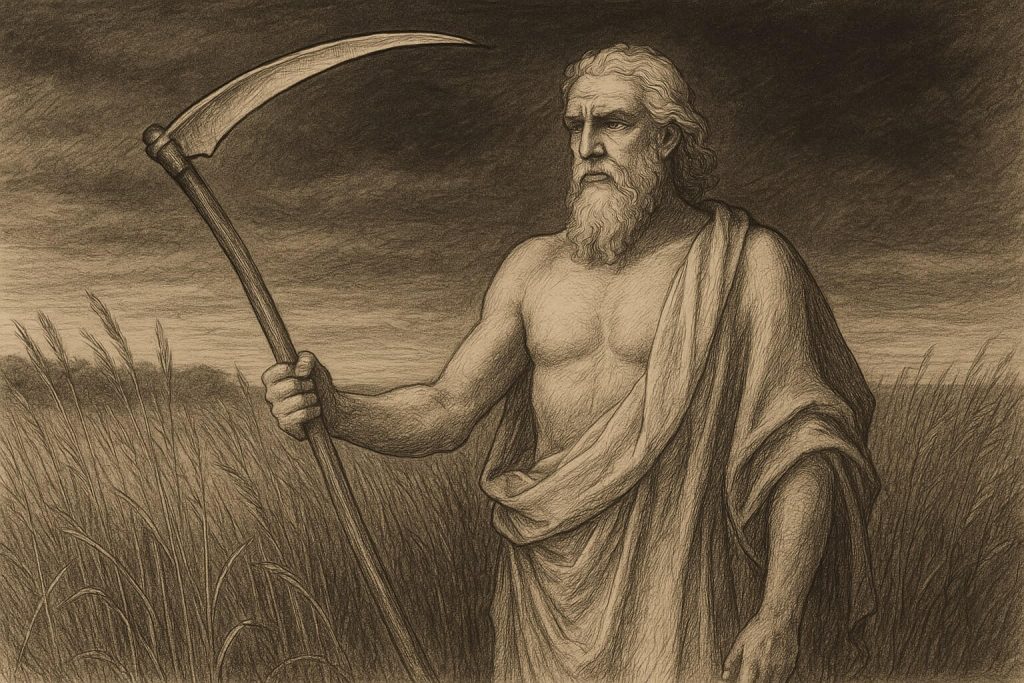
Saturn is often depicted as an old man holding a scythe, an image closely connected to Father Time and the ancient agricultural god Saturn.
I recently visited an old castle and came across an image of the Grim Reaper holding a large scythe. I’ve seen that figure countless times in books, films, and paintings, but this time I immediately thought of Saturn. The connection between the two suddenly seemed so obvious.
The Scythe, Agriculture, and Hard Work
Long before the scythe became associated with death, it was used to cut grass and harvest grain. I remember using one with my grandfather in our garden. We would cut the grass and collect it to feed our rabbits.
Saturn has a strong connection to agriculture, land, and physical labor. In Roman mythology, Saturn was a god of agriculture, and his association with the harvest helps explain why he was depicted carrying a sickle or scythe.
There’s also something very Saturnian about farming. You prepare the soil, plant the seeds, care for the crops, and wait. Months of work may pass before you see the results. And even after all that effort, the harvest depends on timing and conditions beyond your control. Saturn represents that patience, discipline, and responsibility.
Why Saturn’s Scythe Represents Time
You can work as hard as you want, but you still have to wait for crops to ripen. Harvest them too early, and they may be useless. Leave them too long, and they can spoil.
Saturn rules time, aging, delays, and maturity in astrology. Its scythe represents the moment something has reached the end of its development and is ready to be harvested.
This also connects Saturn to Father Time, the familiar elderly figure carrying a scythe and sometimes an hourglass. The hourglass measures the passing of time, and the scythe represents its eventual conclusion.
Even Saturn’s position in the ancient planetary order fits this symbolism. It was the farthest planet visible to the naked eye, marking the outer boundary of the traditional seven-planet system. Beyond Saturn lay the unknown.
Saturn’s Scythe and the Grim Reaper
The Grim Reaper carries a scythe because death has long been compared to harvesting. Just as a farmer cuts grain at the end of its growing season, the Reaper represents the end of human life.
Saturn has similar associations in traditional astrology. It rules old age, physical decline, mortality, and the limits of the human body.
The scythe is also a dangerous tool if handled carelessly. I remember using one in the garden with my grandfather and having to watch every movement. A single mistake could cause a serious injury.
This connects to another Saturnian theme: responsibility and consequences. The same scythe that helps a farmer gather food can also cause harm, depending on how it’s used.
From Harvest to Death
Saturn carries a scythe because of his ancient connection to agriculture, harvest, and the passage of time. In Roman mythology, Saturn was an agricultural god, often depicted holding a sickle. Over the centuries, this imagery became closely associated with Father Time, old age, and death.
In astrology, Saturn is the planet of time, limitations, maturity, and endings. The scythe captures all of these associations. A farmer waits for the crops to ripen before cutting them, just as Saturn is associated with results that come after years of work and patience.
The same blade that harvests grain also became a symbol of mortality in the hands of the Grim Reaper. Both images remind us that everything has its season, from the beginning of growth to its eventual end.
More Saturn Symbolism and Meanings
- How Saturn Returns Karma to People Who Wrong You in Astrology
- Saturn’s Negative Effects in Astrology: Devil or Relentless Teacher?
- How to Celebrate Saturnalia, the Season of Rest and Reversal
- Saturn in Aries 2025–2028: A Global Reset and the Birth of a New Era