

As a kid, I was reckless. Jumping out of trees, wiping out on my bike, climbing rooftops I had no business being on, you name it. And yet I always walked away intact. No broken arms. No cracked ribs. Not even a fractured finger.
Meanwhile, some of my friends seemed almost unlucky by comparison. One snapped his wrist stepping off a curb. Another ended up in a cast after tripping during a game of tag. They used to joke that I was made of rubber, untouchable no matter how many risks I took.
Decades later, the pattern is still there. Plenty of falls, spills, and close calls, but not a single broken bone. With TikTok drawing renewed attention to what’s now called the broken bone theory, I started wondering whether this recurring outcome is more than coincidence.
What the Broken Bone Theory Suggests
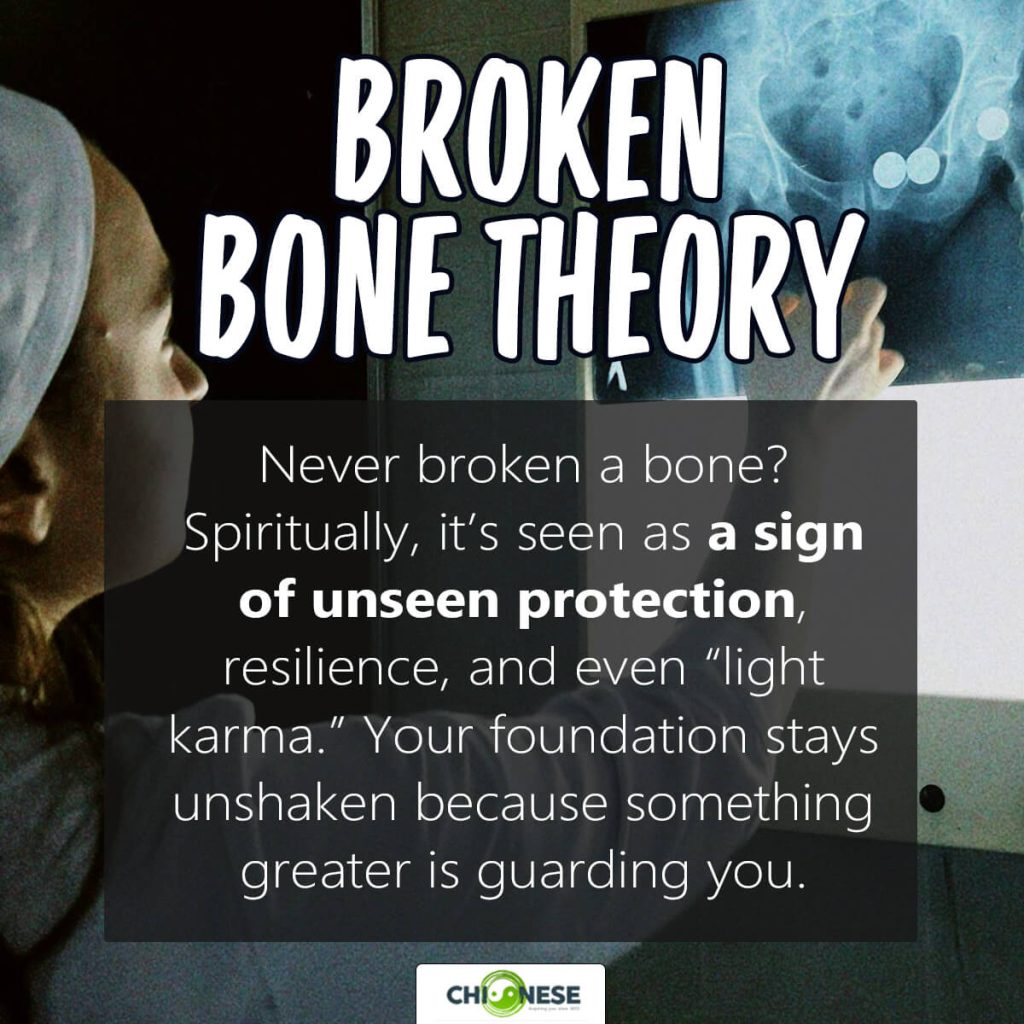
Broken bone theory suggests that some people move through life without breaking bones because physical injury is not the way their challenges tend to arrive. Even with frequent falls, accidents, or risky situations in childhood and adulthood, their bones remain intact. Where some people fracture bones from relatively minor mishaps or seem to break something every few years, others experience the opposite outcome despite similar or greater physical stress.
On a spiritual level, never breaking a bone is often understood as support around the body’s structure, where impact is absorbed without leading to collapse or damage.
This does not mean someone is immune to harm or has unusually strong bones. Everyone has the same basic anatomy, and accidents still happen. But when fractures consistently do not occur over time, that consistency becomes meaningful and is often interpreted as a form of protection operating beneath the surface.
Strong Protection Around the Body
Bones form the body’s load-bearing structure. They take impact first. They absorb pressure long before muscles or skin are involved. In many traditions, bones are linked to lineage and continuity, the part of the body that carries what came before you. From this perspective, moving through life without ever breaking a bone is sometimes read as ancestral protection, support that shows up not through DNA alone, but through the body’s physical framework itself.
Other interpretations focus less on ancestors and more on accumulation. Some view unbroken bones as the result of balance built over time, where past actions, choices, or restraint reduce the need for physical interruption. There are also views tied to life force, the idea that steady internal energy reinforces the body from within, helping it withstand stress without structural damage.
Different explanations exist, but they all circle the same observation: when the body’s foundation consistently holds, people look for meaning in what keeps it that way.
Bones as a Reflection of Inner Strength
Bones absorb pressure without announcement. They carry weight, impact, and strain while the rest of the body keeps moving. Most of the time, they do their work unnoticed.
Within broken bone theory, this physical role becomes symbolic. When someone’s bones remain intact through repeated stress, it is often read as a sign that their internal structure holds under pressure. Challenges land, the body adjusts, and the foundation stays intact. Stress is absorbed rather than transferred into collapse.

Minimal Physical Karma
Karma is not limited to relationships, timing, or external circumstances. In many spiritual frameworks, it is also understood as something that can register through the body itself, showing up as patterns of strain, interruption, or recovery over time.
Recurring injuries, repeated accidents, or ongoing physical setbacks are sometimes interpreted as how certain lessons take form. Within broken bone theory, the absence of fractures suggests that those lessons may not need to arrive through physical damage. Instead, pressure may be expressed through responsibility, emotional intensity, difficult choices, or long-term inner shifts.
This interpretation does not assign value or blame to injury. Breaking a bone is not a sign of failure or imbalance. Bodies respond to gravity, movement, and chance. Slipping on ice or misjudging a step does not require a spiritual narrative.
Broken bone theory simply observes that some people experience fewer physical interruptions across their lives, while growth unfolds through emotional, mental, or relational experiences instead. The body remains intact, even as life continues to apply pressure elsewhere.
More Than Biology Alone
Bone density can play a role. Coordination matters too. Chance is always part of the equation. Broken bone theory does not dismiss biology or physical factors. It exists alongside them, not in opposition.
Still, patterns invite attention. If you have never broken a bone, it suggests that your body carries you through life with a certain steadiness. I am a clear example of this. I am constantly on the move. I travel often, climb mountains, skate on ice, and fall almost every year. Even so, well into my thirties, I have never broken a bone.
Whether this comes down to protection, resilience, or something harder to define, the pattern itself remains. And when the same outcome repeats across years of movement, impact, and risk, it raises a reasonable question. There may be more to it than chance alone.