

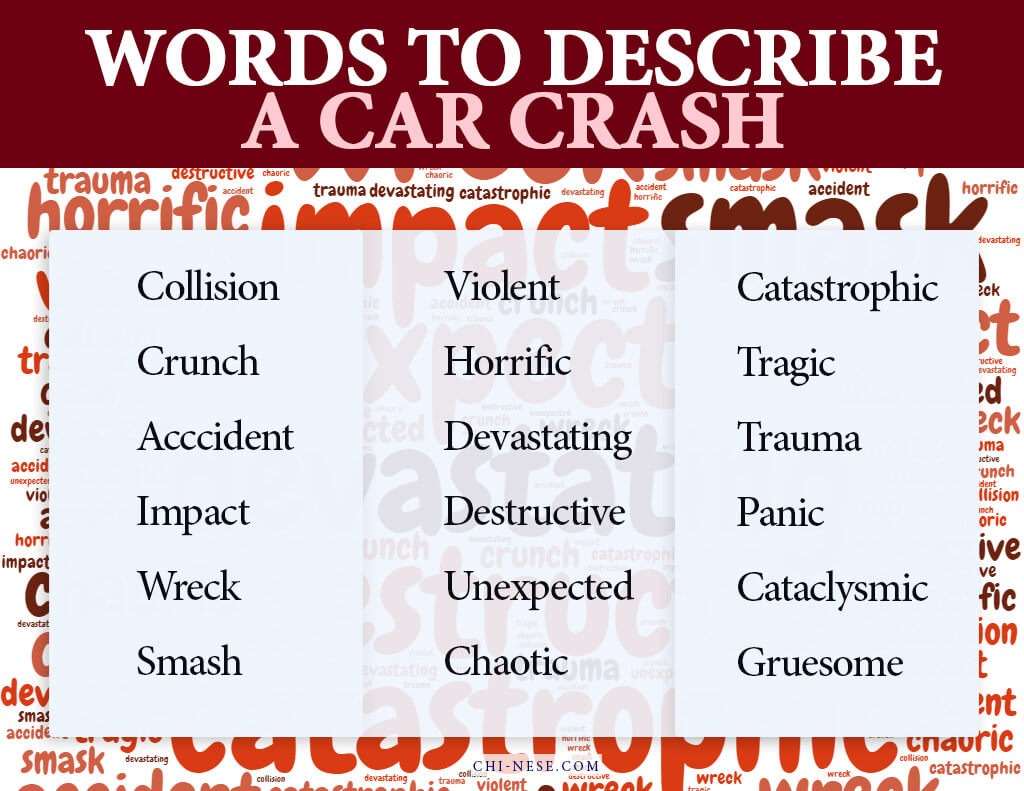
The best words to describe a car crash include violent, devastating, severe, jarring, chaotic, terrifying, sudden, destructive, traumatic, and shocking. The right word depends on the severity of the collision, what physically happened, and how the people involved experienced it.
A minor accident might be described as a bump, fender bender, scrape, or low-speed collision, while a serious crash may be violent, catastrophic, fatal, or devastating. For creative writing, words such as crunch, smash, screech, impact, and shatter can capture the sounds and movement of the crash. Below are adjectives, nouns, sounds, and feelings with their meanings and examples.
Adjectives to Describe a Car Crash
| Word | Meaning | Example |
|---|---|---|
| Violent | Involving considerable physical force | The violent crash pushed both vehicles across the intersection. |
| Severe | Causing serious damage or injuries | The highway was closed following a severe two-car crash. |
| Devastating | Causing extensive damage, injury, or loss | The devastating collision left several vehicles badly damaged. |
| Catastrophic | Involving extremely serious destruction or consequences | A catastrophic crash blocked several lanes of the highway. |
| Fatal | Resulting in the death of at least one person | Police were investigating a fatal crash on the rural road. |
| Jarring | Sudden and physically shocking | The jarring impact threw everything inside the car forward. |
| Chaotic | Involving confusion, disorder, and several things happening at once | The scene became chaotic as traffic backed up around the damaged vehicles. |
| Destructive | Causing extensive physical damage | The destructive impact crushed the front of the vehicle. |
| Harrowing | Extremely distressing or frightening to experience | The passengers described the crash as a harrowing experience. |
| Traumatic | Causing serious emotional or psychological distress | The traumatic accident stayed with him long after his injuries healed. |
| Sudden | Happening quickly and with little warning | The sudden collision gave the driver almost no time to react. |
| Shocking | Causing strong surprise, distress, or alarm | Witnesses were shaken by the shocking scene. |
| Tragic | Involving serious loss, suffering, or death | The community gathered after the tragic accident. |
| Disorienting | Leaving someone confused about their surroundings or what happened | The impact was so disorienting that she struggled to recall the next few seconds. |
| Terrifying | Causing intense fear | The passenger described the rollover as terrifying. |
| High-speed | Occurring while one or more vehicles are traveling at high speed | The high-speed collision caused extensive damage to both cars. |
| Head-on | Involving the fronts of two vehicles colliding | Emergency crews responded to a head-on crash. |
| Multi-vehicle | Involving several vehicles | The snowstorm contributed to a multi-vehicle crash on the interstate. |
| Low-speed | Occurring at relatively low speed | The low-speed collision caused minor bumper damage. |
| Minor | Causing limited damage or injury | It was a minor crash involving two parked cars. |

Nouns for a Car Crash
These nouns describe different types of collisions, movements, and physical events associated with a crash.
| Word | Meaning |
|---|---|
| Collision | An event in which a vehicle strikes another vehicle, person, or object |
| Impact | The moment when two objects forcefully make contact |
| Accident | An unintended event that causes damage or injury |
| Crash | A collision involving a vehicle |
| Wreck | A serious crash or the badly damaged vehicle left afterward |
| Fender bender | An informal term for a minor vehicle accident |
| Pileup | A crash involving several vehicles, often one after another |
| Rollover | A crash in which a vehicle rolls onto its side or roof |
| Sideswipe | A collision in which the sides of two vehicles make contact |
| Rear-end collision | A crash in which one vehicle strikes another from behind |
| Head-on collision | A crash in which the fronts of two vehicles collide |
| T-bone collision | A crash in which the front of one vehicle strikes the side of another |
| Jackknife | A truck accident in which the trailer swings toward the cab at an angle |
| Skid | Uncontrolled sliding caused by loss of tire traction |
| Spin | Uncontrolled rotation of a vehicle |
| Debris | Broken vehicle parts, glass, and other material scattered after a collision |
| Wreckage | The severely damaged remains of a vehicle or vehicles |
Words to Describe the Sound of a Car Crash
Car crashes can involve several distinct sounds in only a few seconds. These words are especially useful in stories and eyewitness descriptions.
| Word | Sound It Describes |
|---|---|
| Bang | A sudden, loud impact |
| Crash | A loud sound of objects striking and breaking |
| Crunch | The sound of metal or another material being crushed |
| Smash | A forceful impact accompanied by breaking or destruction |
| Screech | A high-pitched sound from tires braking or skidding |
| Squeal | A sharp tire sound caused by braking or loss of traction |
| Crack | A short, sharp breaking sound |
| Shatter | The breaking sound of glass |
| Thud | A heavy, dull impact |
| Scrape | The sound of metal or another hard surface dragging against something |
| Clatter | A series of hard, irregular sounds, often from debris |
| Boom | A deep and powerful impact sound |
In descriptive writing, combining sounds with physical movement can make the scene clearer: tires screeched, glass shattered, and metal crunched on impact.
Words for a Minor Car Crash
A small parking-lot accident requires different language from a serious highway collision. Useful words and phrases for a minor crash include fender bender, bump, scrape, minor collision, low-speed crash, slight impact, and rear-end accident.
Fender bender is common in informal conversation, especially when the damage is limited. Minor collision and low-speed collision sound more neutral and work better in formal descriptions.
Words for a Serious Car Crash
For a crash involving extensive damage, serious injuries, or loss of life, more precise terms include severe, violent, devastating, catastrophic, high-speed, fatal, head-on, multi-vehicle, and destructive.
These words carry different meanings. Fatal should only describe a crash in which someone died, while catastrophic suggests exceptionally severe consequences. High-speed describes the circumstances of the collision and says nothing by itself about injuries or fatalities.
Feelings After a Car Crash
People can experience a wide range of emotions during and after a collision.
| Feeling | Meaning |
|---|---|
| Fear | A strong response to immediate danger |
| Shock | A stunned or overwhelmed reaction following the event |
| Panic | Intense fear that can make clear thinking difficult |
| Anxiety | Worry or nervousness following the crash |
| Grief | Deep sadness connected with serious injury or loss |
| Anger | Frustration or resentment about what happened |
| Guilt | Feeling personally responsible for the collision or its consequences |
| Relief | A sense of reassurance after realizing the danger has passed |
| Disbelief | Difficulty accepting or processing what happened |
| Confusion | Difficulty understanding the sequence of events |
| Helplessness | Feeling unable to control or improve the situation |
| Numbness | Feeling emotionally detached following an overwhelming experience |
| Regret | Wishing a decision or event had unfolded differently |
| Gratitude | Appreciation for surviving or receiving help |
Choosing the Right Word
Choose a word that describes the specific part of the crash you want to communicate. Collision, impact, rollover, sideswipe, and pileup explain what physically happened. Minor, severe, violent, high-speed, and fatal describe the circumstances or severity. Jarring, terrifying, harrowing, and shocking capture how the experience felt.
For factual writing, precision is especially important. A fatal crash has a specific meaning, while words such as horrific or devastating express an evaluation of the event. In creative writing, sounds such as crunch, screech, bang, and shatter can make the scene easier to picture.
More Descriptive Words
- Words To Describe Feeling Bad For Someone (With Meanings & Examples)
- Words To Describe Pizza (Its Taste, Flavor, Smell & Texture)
- Words to Describe Disgusting Food
- Polite Words to Describe a Fat Person Without Sounding Rude
- Words to Describe Chocolate (Taste and Texture Adjectives)