

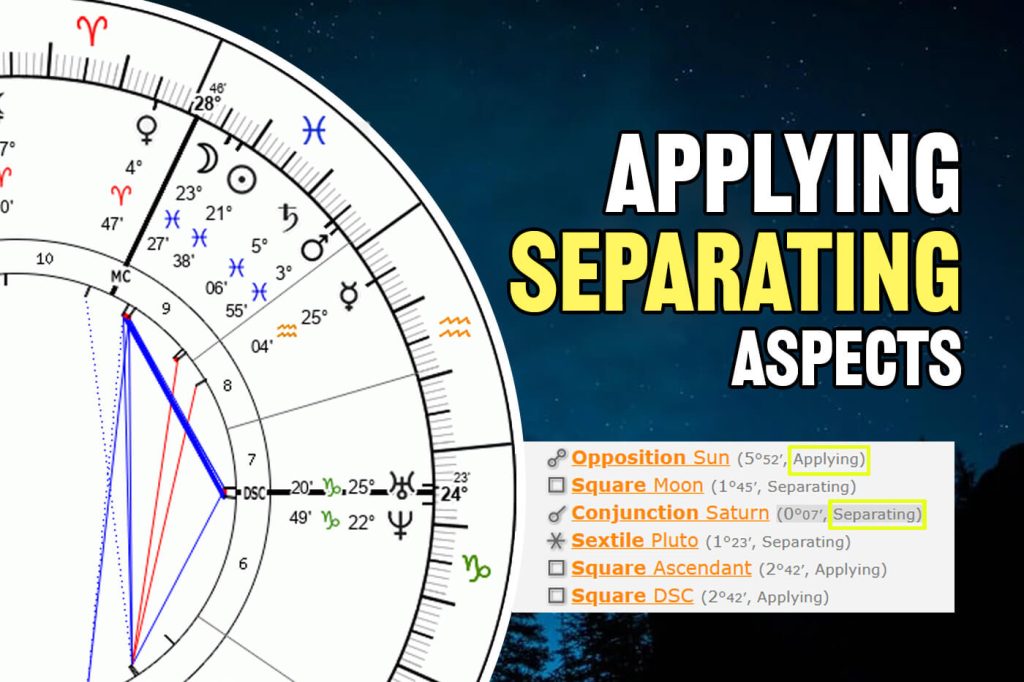
If you’ve ever looked at your chart or current transits and felt confused by terms like applying and separating, I’m here to clarify them. These two concepts may sound technical, but once you understand them, astrology becomes much more tangible and emotionally accurate.
Applying Aspect
An applying aspect occurs when two planets are moving toward exact contact. The faster planet has not yet reached the exact degree of the aspect, but it is steadily getting closer.
This is the phase where energy builds. Emotionally, mentally, and physically, things often feel heavier, louder, or more intense. Applying aspects can feel unavoidable, as if something is forming regardless of whether you are ready for it.
That’s why applying aspects are usually experienced as more difficult. You are moving toward the peak of the experience, but you haven’t reached it yet.
Example: Applying Sun Square Saturn
Let’s say you have the Sun at 23° Gemini and Saturn at 23°10 Pisces. This is an applying square, almost exact, separated by only ten minutes. Applying means that the Sun is moving toward the square with Saturn, not the other way around.
In this phase, pressure builds quickly. Responsibilities feel heavier. Self-doubt can creep in, along with fatigue or frustration, and a sense that life is asking more of you than you can comfortably give. A Sun–Saturn square is demanding on its own, but when it’s applying, the weight feels stronger.
You can feel the pressure approaching, and that anticipation alone can be exhausting.
Separating Aspect
A separating aspect occurs when the exact contact has already happened and the faster planet is moving away from it.
This is the aftermath phase. The event, realization, or internal shift already occurred. What remains is the echo of it.
Separating aspects still matter, but they feel different. There is tension, but it is no longer tightening. Instead, it slowly loosens.
Example: Separating Sun Square Saturn
Now imagine the Sun at 25° Gemini squaring Saturn at 23°10 Pisces. The exact square already occurred when the Sun was closer to 23°. What you’re experiencing now is the residue. The aftertaste. The half-empty glasses left behind after a long night.
You may still feel tired, serious, or restricted, but there’s usually a quiet sense that the hardest part is behind you. Clarity begins to return. The pressure is no longer increasing. It’s slowly loosening its grip.
That’s why separating aspects often feel more manageable than applying ones, even when the same planets are involved.
Why Applying Aspects Feel Harder
Applying aspects are about anticipation and escalation. You are moving toward something, not away from it.
Imagine a snowball rolling downhill. When the aspect is applying, the snowball is still growing as it rolls. Each degree adds more weight. You can feel it coming, but you cannot stop it yet.
At the exact aspect, the snowball is at its largest and hits full impact.
Once the aspect becomes separating, the Sun starts warming things up. The snowball does not disappear instantly, but it begins to melt. The intensity slowly reduces.
This is why many people suddenly feel lighter a few degrees after an exact transit, even though the aspect is technically still there.

Natal Aspects vs Transit Aspects
In a natal chart, applying and separating aspects describe how you carry that energy internally.
An applying natal aspect often feels like a lifelong theme that is always pulling you forward. There is a sense of tension or motivation that never fully resolves. A separating natal aspect often feels like something you have already learned how to handle, even if it still influences you.
In transits, the difference is much easier to observe because you can feel it happening in real time.
When a transit is applying, you usually notice mounting pressure, emotional buildup, or increasing stress. Thoughts loop. Situations intensify.
When the transit turns exact, everything crystallizes.
When it becomes separating, relief begins. You may not feel instantly better, but you can usually tell the direction has changed.
Why This Matters in Real Life
Understanding whether an aspect is applying or separating helps you avoid unnecessary panic.
If you’re in an applying transit, it explains why things feel heavier each day. It’s not in your head. You’re approaching the peak of the experience.
If the aspect is separating, it explains why you may feel drained yet oddly calmer at the same time. The hardest part has already passed.
For example, you might be planning a trip and notice Venus opposite Mercury in transit. At first glance, that can feel worrying. But if you see that the aspect is already separating by more than a degree, you can usually relax. The peak has already occurred. That doesn’t mean nothing can happen, but the intensity is no longer building.
Yes, slower-moving planets tend to linger, and their effects can still be felt several degrees after the exact aspect. Inner planets like Venus, Mercury, and Mars, however, tend to move through aspects more quickly, making the applying versus separating phase especially noticeable.
The Moment Between Pressure and Release
Applying aspects describe something that is still building. Separating aspects describe something that has already peaked. That difference matters far more than people realize, especially when you are trying to understand pressure, relief, or timing in real life.
These aspects show us that astrology is not static. Energy moves. Builds. Peaks. Dissolves. Applying aspects ask for endurance. Separating aspects allow integration.
When you know which phase you are in, you stop fighting the timing and start working with it. That alone can make difficult transits feel far more navigable.