

Did you know that the word robot comes from Czech? As a native Czech speaker, I’ve always found it amusing that a word associated with futuristic machines, artificial intelligence, and science fiction originated in my language more than a century ago.
The Czech Republic has given the world inventions such as sugar cubes and soft contact lenses, but the word robot has traveled even further. It’s used in languages across the world, often with almost identical spelling and pronunciation. And its original meaning has surprisingly little to do with technology.
Who Invented the Word Robot?
The word robot became famous thanks to Czech writer Karel Čapek, who introduced it in his 1920 play R.U.R. (Rossum’s Universal Robots). The play premiered in Prague in 1921 and soon reached theaters around the world. But Karel wasn’t the person who came up with the name.
According to Čapek’s own account, he was struggling to name the artificial workers in his play. He considered calling them laboři, derived from the Latin word for labor. His brother Josef Čapek, a painter and writer, suggested roboti instead.
Karel liked the suggestion, and the word eventually entered the vocabulary of millions of people.
Interestingly, the robots in R.U.R. were quite different from the machines we imagine today. They were artificially manufactured biological beings, created to work for humans. They resembled people and were designed to perform labor without the needs and freedoms of ordinary human workers.
What Does Robota Mean in Czech?
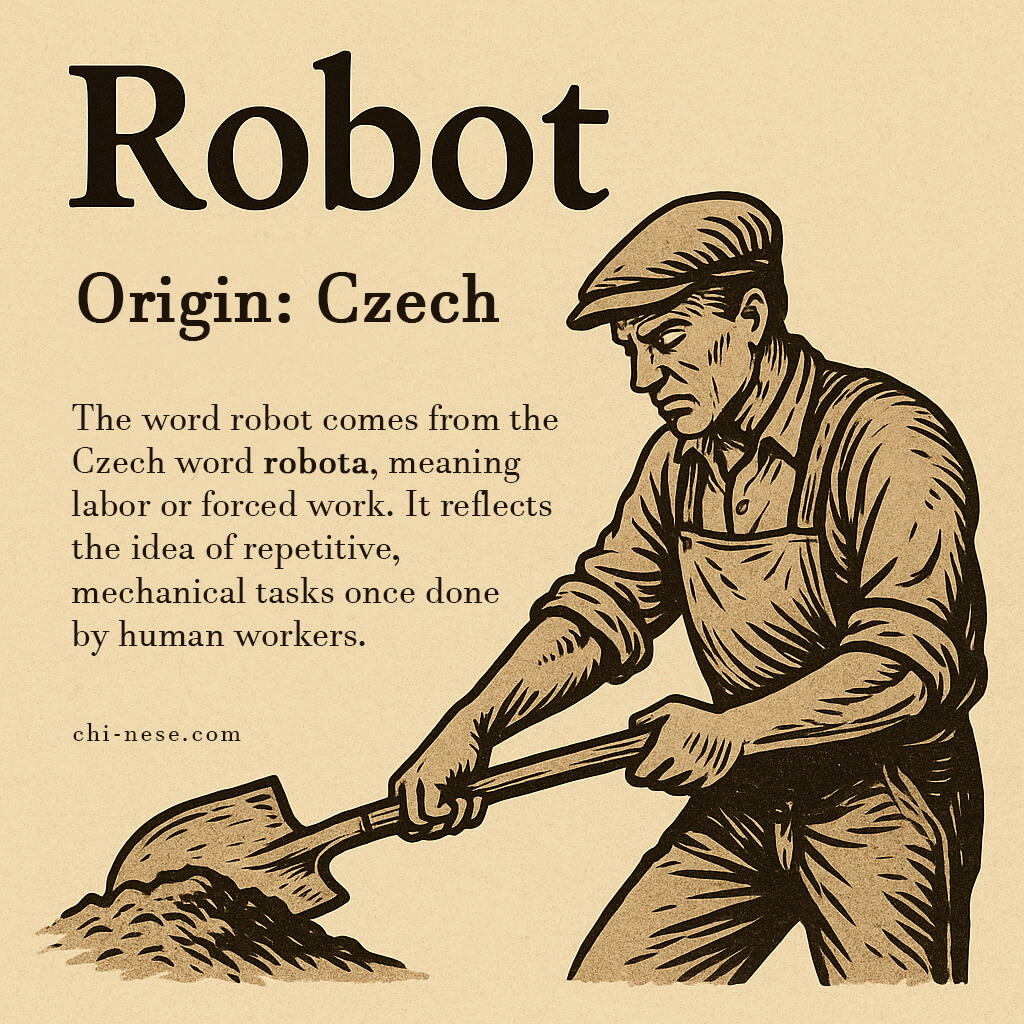
The word robot comes from the Czech robota, meaning forced labor, compulsory work, or drudgery. Historically, robota referred to labor that peasants were required to perform for their landlords under the feudal system. It could involve working in fields, maintaining estates, or completing other physically demanding tasks without receiving ordinary wages.
For Czech audiences watching R.U.R., the connection was immediately recognizable. Čapek’s artificial workers existed to serve their human creators, much like peasants who had once been obligated to work for landowners.
In modern Czech, the everyday word for work is práce. The word robota survives mainly in historical discussions and informal expressions, especially those describing exhausting or unpleasant work.
You might still hear someone complain, To je ale robota!, meaning something like “What a lot of hard work!”
How Robot Became an International Word
After R.U.R. premiered in Prague in 1921, it quickly attracted international attention. The play was translated into numerous languages and performed in major cities, including New York and London.
English-speaking audiences encountered the unfamiliar word robot through the play, and it soon became part of everyday English.
As science fiction developed, its meaning gradually changed. Čapek’s biological workers gave way to the mechanical robots of films, books, and eventually real-world engineering.
Today, the word describes everything from industrial machines assembling cars to robotic vacuum cleaners moving around our homes.
Yet the original idea remains recognizable: a robot is something created to perform work.
The Meaning of Robot Today
More than a century after R.U.R., robots have become part of everyday life. They manufacture products, assist surgeons, explore distant planets, and complete household chores.
The technology has changed enormously, but the Czech origin of the word remains a fascinating connection between medieval labor and modern engineering.
There’s also an interesting irony in Čapek’s choice of name. His play explored the consequences of creating artificial workers to serve humanity, including the possibility that those workers might eventually rebel against their creators.
Those questions are still relevant to discussions about robotics and artificial intelligence today.
As a Czech, I love that one of the world’s most recognizable technological words began with an old expression for hard labor and a conversation between two brothers.
More About Czech Language and Culture
- How to Say Hello in Czech: 11 Common Greetings (With Meanings)
- How Czech Are You? 9 Signs You Belong in the Czech Republic
- Why Is the Czech Republic So Atheist? The History Behind It
- What Does “Škoda” Mean? The Funny Czech Meaning Behind the Car Brand