

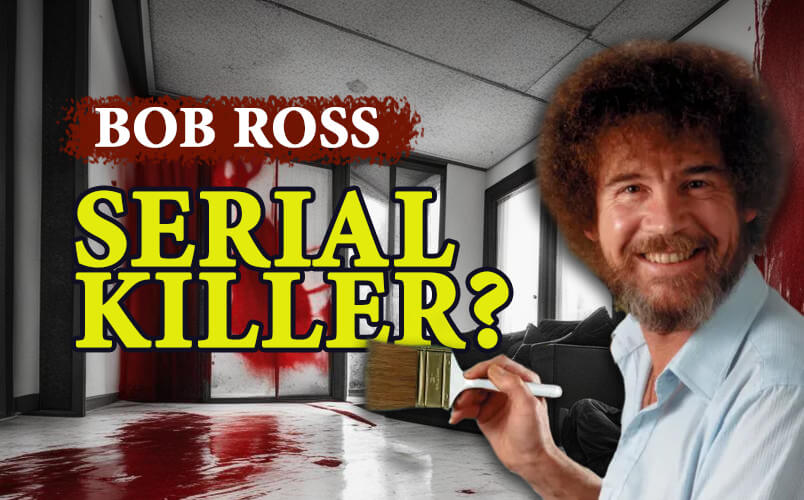
If you’ve spent any time on Reddit, especially in conspiracy or “creepy internet theory” threads, you’ve probably seen this one come up. Someone casually asks a question like: What if Bob Ross wasn’t what he seemed? From there, the idea snowballs fast.
The theory claims that the soft-spoken host of The Joy of Painting may have been hiding something far darker. Some posts go as far as suggesting he was a serial killer who used his paintings as symbolic burial sites. It sounds absurd at first, which is exactly why it keeps resurfacing. People don’t believe it because it’s convincing. They engage with it because it clashes so hard with the image everyone knows.
So where did this idea come from, and why does it still circulate?
Who Bob Ross Actually Was
Bob Ross was born in 1942 and spent much of his early adulthood serving in the U.S. Air Force. During his military years, he learned to paint and later adopted the wet-on-wet technique that allowed him to complete landscapes quickly.
In 1983, The Joy of Painting debuted on PBS. Each episode showed Ross creating a full painting from start to finish, usually a quiet landscape filled with mountains, trees, lakes, and cabins. Over the years, he filmed more than 400 episodes.
His appeal came from contrast. He had a deep voice, steady pacing, and complete confidence in what he was doing. For many viewers, the show felt calming and predictable. For others, especially years later on the internet, that consistency became something people started to read into.
How the Serial Killer Theory Started on Reddit
The theory didn’t start with evidence. It started with a hypothetical.
Around 2017, a Reddit user posted a question asking what it would mean if Bob Ross were a serial killer and if his paintings represented places where bodies were buried. The post was clearly speculative, but it tapped into a familiar internet pattern: taking a wholesome public figure and flipping the narrative.
From there, commenters began stacking coincidences:
- He never painted people
- His landscapes were isolated and empty
- He painted fast and repetitively
- He had a military background
- His calm demeanor felt rehearsed to some viewers
None of these points prove anything. But once a theory gives people a framework, confirmation bias does the rest. Every neutral detail gets reinterpreted as suspicious.
Why His Paintings Get Pulled Into the Speculation
One of the most repeated points is that Bob Ross never included people in his paintings. Every scene is untouched by human presence, aside from the occasional cabin or fence.
Online speculation turns that artistic choice into symbolism. Some users claim the empty landscapes suggest detachment from people or avoidance of human connection. Others argue that the locations look like places where no one would notice if something terrible happened.
In reality, Ross explained this himself. He avoided people because beginners found them difficult to paint, and his goal was accessibility. Trees don’t complain if you get them wrong. Faces do. Still, once a theory exists, explanations get ignored.
If you study my paintings, there are no signs of human life. – Bob Ross
The Zodiac Killer Connection and Why It Falls Apart
Some versions of the theory go further and try to link Bob Ross to the Zodiac Killer. The logic usually relies on age overlap and geography rather than evidence.
The Zodiac crimes occurred in the late 1960s. Bob Ross would have been in his mid-20s at the time, which fits the general age range speculated for the killer. That’s where the connection ends.
There is no forensic evidence, no witness testimony, no timeline overlap that places Ross anywhere near the confirmed Zodiac crimes. Law enforcement has never considered him a suspect. The idea survives purely because of coincidence and shock value.
Why People Keep Revisiting the Theory
The reason this theory won’t die has less to do with Bob Ross and more to do with how the internet works.
People are drawn to contrast. A calm, reassuring public figure makes a better target for dark reinterpretation than someone already controversial. Bob Ross represents safety, repetition, and predictability. Turning that upside down creates discomfort, and discomfort fuels clicks and discussion.
There’s also a broader trend of distrusting public personas. Modern audiences are used to learning that celebrities hid addictions, crimes, or double lives. That mindset gets retroactively applied to figures from earlier decades, even when there’s no supporting evidence.
What the Evidence Actually Says
There is no evidence that Bob Ross committed violent crimes. No accusations surfaced during his lifetime. No investigations followed his death. Friends, colleagues, and family members consistently described him as focused on work, business, and teaching.
The serial killer theory exists entirely online. It’s a thought experiment that escaped its original context and became a recurring piece of internet folklore.
Why the Theory Says More About Us Than Him
This theory persists because it plays with fear and nostalgia at the same time. It challenges the idea that something comforting can stay uncomplicated forever.
Bob Ross built a career on consistency and approachability. The internet builds stories by breaking those things apart. When you put the two together, speculation fills the gap.
Obviously, there’s no hidden case file, no uncovered secret, and no mystery waiting to be solved. Just a painter, a television show, and an internet that likes asking unsettling questions even when the answers aren’t there.