


Most yoga classes use Sanskrit words for poses, breathing exercises, meditation, and philosophical ideas. Asana means posture, pranayama refers to breath regulation, and ahimsa describes the principle of non-harming. Knowing these terms makes yoga instructions easier to follow and helps explain the ideas behind the exercises.
This A-to-Z yoga glossary covers 55 Sanskrit terms, chakra names, yoga styles, and important concepts from Indian philosophy, with short definitions and examples of how they’re used.
A
Asana — A Sanskrit word meaning “seat” or “posture.” Today, asana refers to the physical poses practiced in yoga, from simple seated positions to standing balances and inversions.
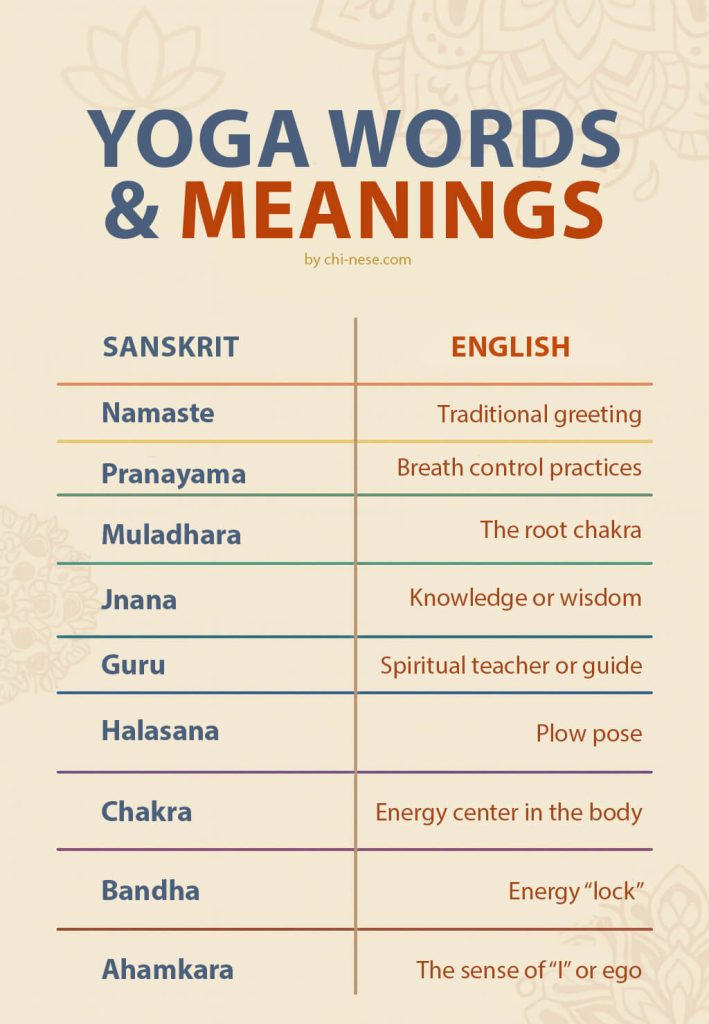
Ahamkara — The sense of “I” or individual identity. In yoga philosophy, ahamkara is associated with the ego and the tendency to identify with thoughts, emotions, and personal experiences.
Ahimsa — Non-violence or non-harming in thoughts, words, and actions. Ahimsa is the first of the five yamas described in Patanjali’s Yoga Sutras.
Anahata — The heart chakra, traditionally associated with love, compassion, forgiveness, and emotional balance. Its Sanskrit name means “unstruck” and refers to the concept of an unstruck sound.
Ajna — The third eye chakra, associated with intuition, insight, and inner understanding. It is traditionally located between the eyebrows.
Avastha — A state or condition. In Indian philosophy, the word can refer to different states of consciousness, such as waking, dreaming, and deep sleep.
Ashtanga — Literally “eight limbs.” The term refers to Patanjali’s eightfold path of yoga and is also used for Ashtanga Vinyasa Yoga, the physically demanding style popularized by K. Pattabhi Jois.
Akasha — Space or ether, one of the five classical elements in Indian philosophy. Akasha represents the element associated with spaciousness and sound.
B
Bandha — A muscular or energetic lock used in certain yoga and breathing exercises. The three principal bandhas are mula bandha (root lock), uddiyana bandha (abdominal lock), and jalandhara bandha (throat lock).
Bhramari — A breathing technique known as “humming bee breath.” It involves producing a humming sound during exhalation and is practiced to support relaxation and concentration.
Bhakti — Devotion or loving dedication to the divine. Bhakti yoga is the path of devotion, expressed through prayer, chanting, worship, and service.
Bikram Yoga — A modern yoga style developed by Bikram Choudhury. It follows a fixed sequence of 26 postures and two breathing exercises in a room traditionally heated to approximately 40°C (105°F).
Buddhi — The faculty of intelligence, understanding, and discernment. In yoga philosophy, buddhi helps distinguish between temporary experiences and deeper understanding.
C
Chaturanga — Short for Chaturanga Dandasana, meaning “four-limbed staff pose.” It resembles a low plank with the elbows bent close to the body and is commonly practiced during sun salutations.
Chakra — A Sanskrit word meaning “wheel” or “circle.” In yoga’s subtle-body teachings, chakras are energy points associated with different physical, emotional, and spiritual qualities. The familiar modern system describes seven main chakras.
D
Dhyana — Meditation or sustained meditative absorption. It is the seventh limb of Patanjali’s eightfold yoga and follows dharana, the practice of concentration.
Dandasana — Staff pose. A seated yoga posture with the legs extended forward, the spine upright, and the hands resting beside the hips.
Duhkha — Suffering, distress, or dissatisfaction. The term describes the discomfort and suffering associated with human existence in several Indian philosophical systems.
Dharana — Concentration on a single object, point, or idea. It is the sixth limb of Patanjali’s eightfold yoga and prepares the mind for meditation.
Drishti — A focused gaze used during yoga poses and meditation. In Ashtanga Yoga, specific drishti points help direct attention and maintain concentration during movement.
E
Eka — The Sanskrit word for “one” or “single.” It is used in many yoga pose names, such as Eka Pada Rajakapotasana, meaning one-legged king pigeon pose.
G
Gomukhasana — Cow face pose. A seated posture in which the knees are stacked and the arms reach behind the back, with one elbow pointing upward and the other downward.
Guru — A spiritual teacher or guide. The word is traditionally associated with someone who helps students develop knowledge and understanding through instruction.
Guna — A quality or characteristic of nature. In Samkhya and yoga philosophy, the three gunas are sattva (clarity and harmony), rajas (activity and movement), and tamas (inertia and heaviness).
H
Halasana — Plow pose. An inverted yoga posture performed lying on the back, with the legs extending overhead toward the floor behind the head.
Hatha — A Sanskrit word associated with force or effort. Hatha yoga traditionally refers to physical and energetic disciplines involving postures, breathing, and other techniques. Later interpretations connect ha with the sun and tha with the moon.
I
Iyengar Yoga — A yoga style developed by B.K.S. Iyengar. It emphasizes precise alignment, careful instruction, and the use of props such as blocks, straps, blankets, and bolsters.
J
Jnana — Knowledge or wisdom. Jnana yoga is the path of self-inquiry, using contemplation and discernment to explore the nature of the self.
K
Kundalini — Spiritual energy traditionally described as resting at the base of the spine, symbolized by a coiled serpent. In certain yogic teachings, its awakening is associated with expanded consciousness and spiritual transformation.
Kirtan — Devotional singing or chanting, usually performed in a call-and-response format. Kirtan commonly uses mantras and the names of Hindu deities.
Kapalabhati — A breathing and cleansing technique whose name means “skull shining.” It involves forceful, repeated exhalations followed by passive inhalations.
Karma — Action and its consequences. In Indian philosophy, karma describes the relationship between intentional actions and their effects on future experiences.
M
Mantra — A sacred sound, syllable, word, or phrase repeated during meditation or devotional practice. Examples are Om and So Hum.
Mudra — A symbolic gesture or seal used in yoga, meditation, and ritual. Hand mudras, such as Jnana Mudra, are used to support concentration and express specific spiritual ideas.
Muladhara — The root chakra, traditionally located at the base of the spine. It is associated with stability, security, survival, and grounding. See these Muladhara affirmations.
Moksha — Liberation from samsara, the cycle of birth, death, and rebirth. Moksha is an important spiritual goal in Hindu philosophical traditions.

N
Namaste — A respectful Sanskrit greeting meaning approximately “I bow to you.” It is commonly accompanied by placing the palms together in front of the chest.
Nadis — Subtle energy channels through which prana is said to flow. Yogic texts describe numerous nadis, with ida, pingala, and sushumna holding particular importance.
Nirvana — Liberation from suffering and the cycle of rebirth, especially in Buddhist philosophy. The word literally relates to extinguishing or blowing out, referring to the cessation of craving and the causes of suffering.
O
Om (Aum) — A sacred syllable used in Hinduism and yoga. It represents ultimate reality in several philosophical teachings and is commonly chanted at the beginning or end of meditation.
P

Patanjali — The sage traditionally credited with compiling the Yoga Sutras, a foundational text describing yoga philosophy, meditation, and the eight limbs of yoga.
Pranayama — The regulation of breath through specific breathing techniques. Pranayama is the fourth limb of Patanjali’s eightfold yoga and is associated with the regulation of prana, or vital energy.
Prana — Vital life energy or life force. In yogic teachings, prana is associated with breathing, vitality, and the energetic processes that sustain life.
Pratyahara — Withdrawal of the senses from external distractions. It is the fifth limb of Patanjali’s eightfold yoga and prepares the mind for concentration and meditation.
S
Samsara — The cycle of birth, death, and rebirth described in Hinduism, Buddhism, and Jainism. Liberation from samsara is a central spiritual goal in these traditions.
Samadhi — A state of deep meditative absorption. It is the eighth and final limb of Patanjali’s eightfold yoga, associated with profound concentration and spiritual realization.
Sahasrara — The crown chakra, traditionally located at or above the top of the head. Its name means “thousand-petaled,” and it is associated with spiritual consciousness and enlightenment.
Savasana — Corpse pose. A resting posture performed lying on the back, usually at the end of a yoga session, allowing the body to relax after physical practice.
Shitali — A cooling breathing technique involving inhalation through a rolled tongue or a modified mouth position, followed by exhalation through the nose.
Swadhisthana — The sacral chakra, traditionally located in the lower abdominal region. It is associated with creativity, pleasure, sexuality, and emotional expression.
T
Tantra — A diverse body of Indian spiritual teachings involving ritual, mantra, meditation, visualization, and other practices. Certain tantric traditions have strongly influenced the development of hatha yoga.
U
Ujjayi — A breathing technique involving a slight narrowing of the throat to create a soft, steady sound during inhalation and exhalation. It is commonly used in Ashtanga and Vinyasa Yoga.
V
Vairagya — Non-attachment or dispassion. In yoga philosophy, vairagya describes the ability to release excessive attachment to desires, possessions, and temporary experiences.
Vishuddha — The throat chakra, associated with communication, truthful expression, and creativity. Its Sanskrit name means “especially pure” or “purification.”
Vedas — Ancient sacred texts of India that form an important foundation of Hindu religious and philosophical thought. The four Vedas are the Rigveda, Samaveda, Yajurveda, and Atharvaveda.
More Words to Explore
- “And So It Is”: The Spiritual Meaning Behind These Powerful Words
- 60 Words to Describe Chocolate (Taste and Texture Adjectives)
- 100+ Funny Words That Start With S: From Smirk to Silly
- Sad Words That Start With S: From Sorrowful to Shattered