


Horary astrology can turn the moment you realize something is missing into a surprisingly detailed search map. A set of keys that vanished somewhere in the house, a ring you last remember wearing days ago, a wallet, documents, a phone, or even a missing pet can all be approached through a chart cast for the moment the question becomes serious.
Unlike natal astrology, horary begins with a specific question and a specific moment. You might ask, Where are my keys? or Will I find my missing ring? The Ascendant represents you, while the house connected with whatever you lost gives you its planetary significator. For most personal belongings, that means starting with the 2nd house and its ruler.
From there, the chart can narrow the search through houses, signs, directions, planetary condition, and aspects. It may point toward a particular part of the home, somewhere high or low, a place near water, a vehicle, another person’s belongings, or even suggest that the object is much closer than you think.
I have personally used horary astrology to find missing cats, keys, documents, and a phone that seemed to have vanished completely. What keeps fascinating me is how literal the symbolism can become. When several different parts of the chart describe the same environment, you suddenly have a much smaller area to search.
Here is how to find lost things using horary astrology, step by step, including which houses to use for possessions and pets and how to read the chart for location clues.
Cast a Chart for the Question
Horary astrology works with a specific question asked at a specific moment. Instead of using your birth chart, you cast a new chart for a question such as:
- Where are my keys?
- Where is my missing ring?
- Will I find my lost wallet?
- Where is my cat?
The question should feel real and important enough that you genuinely want an answer. Repeatedly casting charts for the same missing object can quickly create contradictory symbolism, so work with the original sincere question.
If you are reading the chart yourself, use the time and location where the question became clear in your mind. You can generate the chart using Astro-Seek’s horary chart calculator.
Traditional horary primarily uses the seven visible planets: the Sun, Moon, Mercury, Venus, Mars, Jupiter, and Saturn. This means Scorpio is ruled by Mars, Aquarius by Saturn, and Pisces by Jupiter.
Start With the Correct House
Before looking for directions or room descriptions, identify what has been lost. Different things belong to different houses, so the 2nd house is only the starting point for your own movable possessions.
| What is missing? | House to examine |
|---|---|
| Your keys, wallet, phone, jewelry, clothes, money | 2nd |
| Your car or bicycle | 2nd |
| Letter, document, paperwork | Usually 2nd if it belongs to you; 3rd can add context |
| Sibling’s possession | 4th, the 2nd from the 3rd |
| Child’s possession | 6th, the 2nd from the 5th |
| Partner’s possession | 8th, the 2nd from the 7th |
| Friend’s possession | 12th, the 2nd from the 11th |
| Cat, dog, or other small domestic animal | 6th |
| Large livestock or traditionally larger animals | 12th |
The principle behind the more complicated examples is called turning the chart.
If your partner lost their wallet, for instance, your partner belongs to the 7th house. Their possessions are shown by the 2nd house counted from the 7th, which brings you to the radical 8th house.
What About Lost Pets: 5th or 6th House?

In traditional horary astrology, small animals and ordinary household pets are generally assigned to the 6th house. That includes cats and dogs. Larger animals were traditionally associated with the 12th.
Some modern astrologers use the 5th house for beloved pets because they experience the animal as a child or family member. Emotionally, that makes perfect sense. Technically, however, if you are following traditional horary rules, start with the 6th house ruler for a missing cat or dog.
You can still examine the 5th if it is strikingly emphasized, but I would avoid switching houses simply because one ruler produces a nicer answer. Choose your method before interpreting the chart.
Step 1: Find Your Significator
The Ascendant represents you, the person asking the question. The planet ruling the Ascendant becomes your significator.
| Ascendant | Your significator |
|---|---|
| Aries | Mars |
| Taurus | Venus |
| Gemini | Mercury |
| Cancer | Moon |
| Leo | Sun |
| Virgo | Mercury |
| Libra | Venus |
| Scorpio | Mars |
| Sagittarius | Jupiter |
| Capricorn | Saturn |
| Aquarius | Saturn |
| Pisces | Jupiter |
If Scorpio is rising, Mars represents you. If Pisces rises, Jupiter represents you.
You do not need to turn every Ascendant sign into a psychological description of how upset, confused, or determined you feel. For lost-property work, its most important job is much simpler: the Ascendant identifies the querent and gives you their planetary ruler.
The Moon also deserves close attention. In horary, it helps describe the unfolding of events through its previous and next aspects and frequently acts as a co-significator of the question.
Step 2: Find the Significator of the Lost Item
For your own lost possession, look at the sign on the 2nd-house cusp and find its traditional ruler.
| 2nd-house sign | Ruler of the lost item |
|---|---|
| Aries | Mars |
| Taurus | Venus |
| Gemini | Mercury |
| Cancer | Moon |
| Leo | Sun |
| Virgo | Mercury |
| Libra | Venus |
| Scorpio | Mars |
| Sagittarius | Jupiter |
| Capricorn | Saturn |
| Aquarius | Saturn |
| Pisces | Jupiter |
Suppose you lost your keys and Sagittarius is on the 2nd-house cusp. Jupiter represents the keys.
Now find Jupiter.
Its house can describe the general area, its sign adds information about the surroundings and direction, and its condition can tell you more about how accessible or hidden the object is.
This is where horary begins functioning like a search map.
Step 3: Read the House as a Location
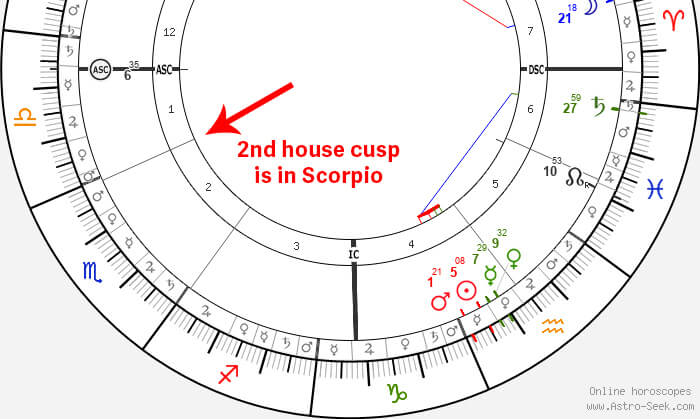
The house containing the object’s significator is one of the first places I look when trying to determine where something has gone.
| House | Possible location clues |
|---|---|
| 1st | Very close to you, your room, clothes, personal belongings, where you are sitting |
| 2nd | Wallets, purses, valuables, money boxes, cupboards, personal storage |
| 3rd | Car, desk, paperwork, books, phone area, hallway, sibling’s space |
| 4th | Home, kitchen, cellar, floor level, storage, family areas |
| 5th | Children’s room, hobby area, entertainment space, games, creative supplies |
| 6th | Work area, utility space, pet supplies, tools, cleaning area, everyday routines |
| 7th | Partner’s belongings, another person’s room, opposite side of the room |
| 8th | Shared possessions, hidden storage, other people’s money or belongings |
| 9th | Books, study area, travel luggage, religious items, foreign objects |
| 10th | Workplace, office, prominent or highly visible places |
| 11th | Friend’s home or belongings, group spaces, social areas |
| 12th | Hidden areas, behind furniture, storage, isolated or difficult-to-see places |
These are location clues, and the strongest interpretations come from several chart factors pointing to the same place.
For example, a 3rd-house significator does not automatically mean “the keys are in the car.” It tells you to investigate 3rd-house environments: the car, desk, paperwork, books, hallway, local travel, siblings, neighbors, or somewhere connected with your recent movements.
Step 4: Check the Sign and Element
The zodiac sign containing the lost object’s significator describes another layer of its surroundings.
Fire Signs: Aries, Leo, Sagittarius
Fire can point toward warm, dry, bright, exposed, or elevated places. Look near heating, fireplaces, lamps, cooking areas, sunny windows, higher shelves, or somewhere receiving plenty of light.
Earth Signs: Taurus, Virgo, Capricorn
Earth signs favor low, practical, enclosed, earthy, or storage-related places. Think floors, cupboards, drawers, boxes, closets, beneath furniture, gardens, sheds, or places where practical objects are kept.
Air Signs: Gemini, Libra, Aquarius
Air can indicate open, elevated, airy, or communication-related spaces. Desks, shelves, windows, books, papers, computers, electronic equipment, passageways, and places where people talk or move through are worth checking.
Water Signs: Cancer, Scorpio, Pisces
Water signs direct attention toward damp, enclosed, private, or water-related areas. Bathrooms, kitchens, sinks, laundry rooms, refrigerators, drinks, pipes, containers holding liquids, or areas close to water can become relevant.
The strongest clues come from repetition. If the object’s ruler is in Pisces, the Moon is in Cancer, and another important significator points toward a water-related area, the repeated water symbolism gives you a much stronger reason to check bathrooms, sinks, laundry areas, drains, containers, or other places connected with water.
Step 5: Use Directions to Narrow the Search
Horary can also give compass directions. The four main directions associated with the elements are:
| Element | Direction |
|---|---|
| Fire | East |
| Earth | South |
| Air | West |
| Water | North |
The individual signs refine them further:
| Sign | Direction |
|---|---|
| Aries | East |
| Taurus | South by East |
| Gemini | West by South |
| Cancer | North |
| Leo | East by North |
| Virgo | South by West |
| Libra | West |
| Scorpio | North by East |
| Sagittarius | East by South |
| Capricorn | South |
| Aquarius | West by North |
| Pisces | North by West |
The houses provide directional information as well, so I prefer looking for agreement between several indicators.
If the object’s ruler repeatedly points west and other relevant factors support the western side of the property, search there first. One isolated directional clue carries much less weight.
You can apply directions on different scales. “West” might mean the western side of your bedroom, house, garden, workplace, neighborhood, or another location depending on what the rest of the chart describes.
Step 6: Is the Object Close or Far Away?
The type of house containing the object’s significator can help estimate how accessible the missing item is.
| House type | Houses | General indication |
|---|---|---|
| Angular | 1, 4, 7, 10 | Strong, prominent, often closer or easier to recover |
| Succedent | 2, 5, 8, 11 | Intermediate |
| Cadent | 3, 6, 9, 12 | More removed, obscured, delayed, or harder to recover |
A lost-item ruler in the 1st house is especially interesting because it can place the possession very close to the querent.
This is when I would search your immediate surroundings again: pockets, handbags, clothes, beneath your chair, between cushions, beside the bed, underneath papers, or inside something sitting directly beside you.
Sometimes we search the entire house while the missing object is less than a meter away.
Step 7: Look at the Planet’s Condition
The condition of the object’s ruler can describe what has happened to it and how easily it can be recovered.
Retrograde
A retrograde significator can describe returning, going backward, retracing steps, or an object returning toward a previous place.
For practical searching, retrace your movements. Go back to where you remember having the item and repeat the route you took afterward.
Retrograde motion alone does not guarantee that something will return, so check the rest of the chart as well.
Combust
A planet very close to the Sun is combust. Symbolically, the object can be obscured, difficult to see, overwhelmed by its surroundings, or somewhere your attention keeps missing.
This can describe an item hidden among other objects or sitting somewhere surprisingly visible while somehow escaping notice.
Strong or Weak Placement
A well-placed significator can suggest the item remains in relatively good condition or in a place where recovery is possible. A severely weakened or afflicted ruler can describe greater difficulty, damage, poor accessibility, or an environment unsuitable for the object.
Again, use several testimonies before reaching a conclusion.
Step 8: Will You Find the Lost Item?
Now compare your significator with the significator of the object.
An applying aspect between them can be an encouraging sign that you and the possession come back together. The Moon’s applying aspects can also describe what happens next and whether another planet becomes involved before recovery.
That third planet can sometimes represent another person who finds the object, moves it, tells you where it is, or helps return it.
Separating aspects can be useful too. They describe something that has already happened and can occasionally help reconstruct the circumstances surrounding the loss.
For example, the Moon’s last aspect may correspond surprisingly well with where you were or what you were doing shortly before realizing the item was gone.
The 4th House Gives Another Location Clue
For lost-property questions, I also pay attention to the 4th house and its ruler. It can provide additional information about the place where the missing object ended up.
This becomes particularly useful when the 2nd-house ruler gives a broad description.
Suppose the ruler of your missing item is in an earth sign, suggesting somewhere low or enclosed. If the 4th-house ruler also points toward the home and a lower part of the property, I would search floors, cupboards, low shelves, boxes, beneath furniture, storage areas, and the bottom of bags before looking elsewhere.
The more symbolism repeats, the narrower your search becomes.
The Part of Fortune Can Confirm the Location
The Part of Fortune can be used as another supporting indicator in lost-object horary.
Check its sign, house, and ruler. I would rarely base the entire search on the Part of Fortune alone, but it becomes useful when it confirms something you have already seen.
For instance, the ruler of the 2nd points north. The Moon points north. The Part of Fortune also falls in a water sign associated with north.
Now you have a pattern.
Horary becomes much more convincing when several independent clues keep describing the same place.
Example: Finding Lost Keys

Imagine you realize your keys are missing and cast a horary chart.
You have:
- Scorpio rising, so Mars represents you.
- Sagittarius on the 2nd-house cusp, so Jupiter represents the keys.
- Jupiter in Gemini in the 7th house.
Start with the 7th house. It is angular, so the keys may be relatively accessible. The 7th can also connect them with another person, particularly a partner or someone directly involved with you.
Then look at Gemini. It is an air sign, bringing in themes of papers, books, desks, communication devices, movement, vehicles, or places containing multiple small objects. Directionally, Gemini points approximately west by south.
Instead of jumping immediately to one location, combine those clues:
Another person + angular house + air/Gemini environment + west-southwest.
Perhaps your partner moved the keys. Maybe they are on their desk beneath paperwork. They could be inside a shared car, near a laptop, beside mail, or mixed among another person’s belongings on the western side of the room.
Now suppose the Moon applies to Jupiter. That adds another encouraging testimony for recovery.
That is how I approach lost-object horary: build a description from several clues instead of forcing one placement to provide the entire answer.
Example: Finding a Missing Cat
For a missing cat, start with the 6th house.
Imagine Virgo is on the 6th-house cusp. Mercury therefore represents the cat.
Mercury falls in Cancer in the 4th house.
Immediately, several useful clues emerge. The 4th is angular and strongly connected with the home or property, suggesting the cat may remain close to home. Cancer is a water sign and points north, so I would search the northern part of the property and places associated with moisture, shelter, containers, food, or domestic activity.
For an outdoor search, that symbolism could describe somewhere near a water container, drain, damp ground, cellar entrance, sheltered area beside the house, or another protected place.
If your own significator applies to Mercury, or the Moon brings the two significators together, the chart becomes more encouraging for reunion.
And with a missing animal, horary should supplement a real-world search: checking sheds and garages, asking neighbors to inspect enclosed spaces, searching at quieter hours, contacting shelters and vets, and using the usual lost-pet methods remain essential.
The Most Important Rule: Look for Repetition
A lost-object horary chart rarely works best when you read one placement in isolation.
Imagine the ruler of the 2nd is:
- in a water sign,
- in the 4th house,
- north of the Ascendant,
- close to the IC,
- and the Part of Fortune repeats the same direction.
That is a much stronger case for searching the northern, lower, private, or water-related part of the home than simply seeing one planet in Pisces and immediately checking the bathroom.
Think of the chart as several witnesses describing the same scene. One gives you the direction. Another describes the room. Another tells you whether the object is high or low. Another suggests who may have touched it.
When several of them begin telling the same story, you know where to search.
Finding Lost Things With Horary Astrology
To find a lost item with horary astrology, start with the Ascendant for yourself and the 2nd house ruler for your personal belongings. Then examine the object’s significator by house, sign, direction, condition, and aspects, together with the Moon, 4th house, and Part of Fortune. For a missing cat, dog, or other small pet, use the 6th house instead of the 2nd.
The biggest mistake is trying to turn one placement into an exact address. Horary works much better when you combine clues. If the house, sign, direction, Moon, and other relevant factors repeatedly describe the same environment, your search area can become surprisingly specific.
And sometimes the chart leads you back to the most annoying answer of all: the keys really were sitting somewhere you had already checked twice.
More Astrology Guides
- How Applying and Separating Aspects Work in Astrology
- Mystic Rectangle in Astrology: How This Pattern Works in a Chart
- Intercepted Houses and Signs in Astrology: The Hidden Energy in Your Chart